The market will show a downward trend in the short term, and then rebound and set new highs in the second half of the year.The market will show a downward trend in the short term, and then rebound and set new highs in the second half of the year.

Q2 Market Insights: Bitcoin regains dominance in risk-averse environment, ETFs remain critical to market structure

2025/04/28 19:40

Author:Coinbase & Glassnode

Compiled by: Felix, PANews

Crypto markets are experiencing a major correction as we head into the second quarter of 2025. Amid heightened macro uncertainty, investor sentiment has turned defensive, with funds flocking to high-cap assets such as Bitcoin. Despite the pressure on the altcoin market, core infrastructure continues to strengthen, on-chain fundamentals remain strong, and institutional interest remains stable through ETF channels and platform development.

This report, produced jointly by Coinbase and Glassnode, focuses on market structure, position trends, and key indicators in a complex and rapidly evolving environment. The following is the essence of the report:

Crypto Market Pullback Highlights Defensive Positioning
Q2 Market Insights: Bitcoin regains dominance in risk-averse environment, ETFs remain critical to market structure

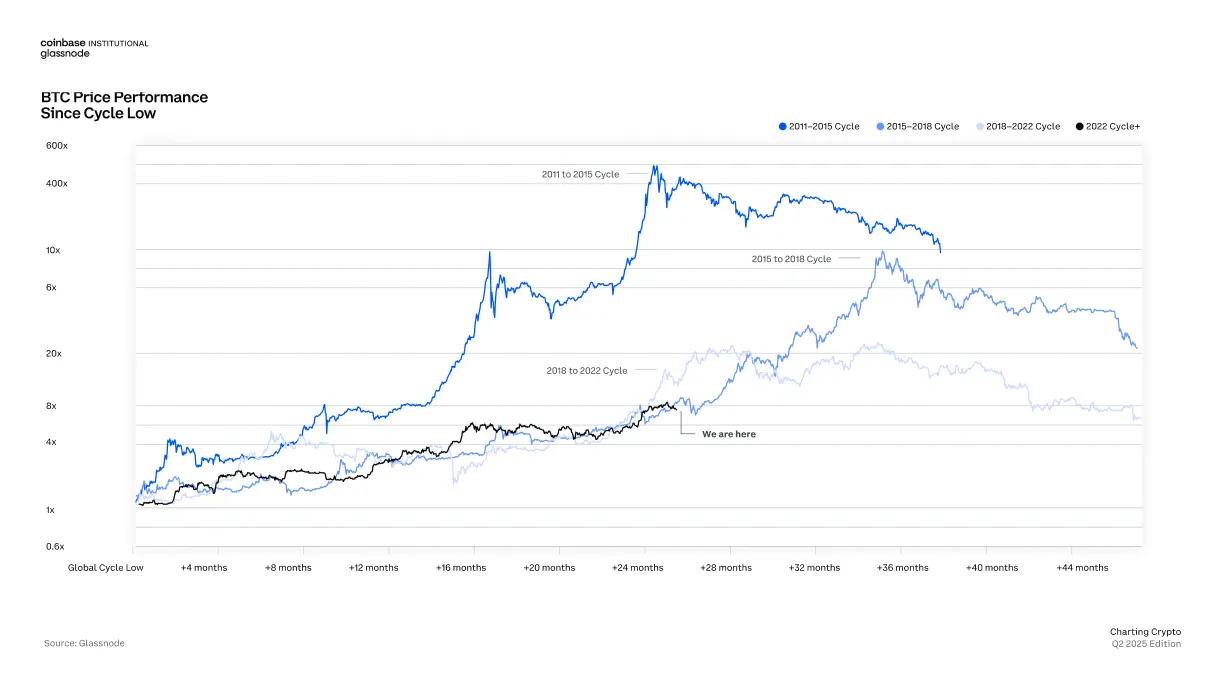
 Bitcoin 's cycle in 2022 and beyond is different from previous trends, and the recovery process is slower against the backdrop of macro uncertainty

Investor sentiment has changed dramatically since the beginning of 2025. Growing concerns about a potential US recession, fiscal tightening, and global trade frictions have triggered risk aversion in the digital asset market. Excluding BTC, the total cryptocurrency market cap is $950 billion, a sharp drop of 41% from the high of $1.6 trillion in December 2024 and a 17% drop from the same period last year. Venture capital inflows have fallen back to the levels of 2017-2018. Both Bitcoin and the COIN50 index have fallen below their 200-day moving averages. This suggests that the current correction may extend until mid-2025.

Bitcoin regains dominance amid risk-off environment
Q2 Market Insights: Bitcoin regains dominance in risk-averse environment, ETFs remain critical to market structure

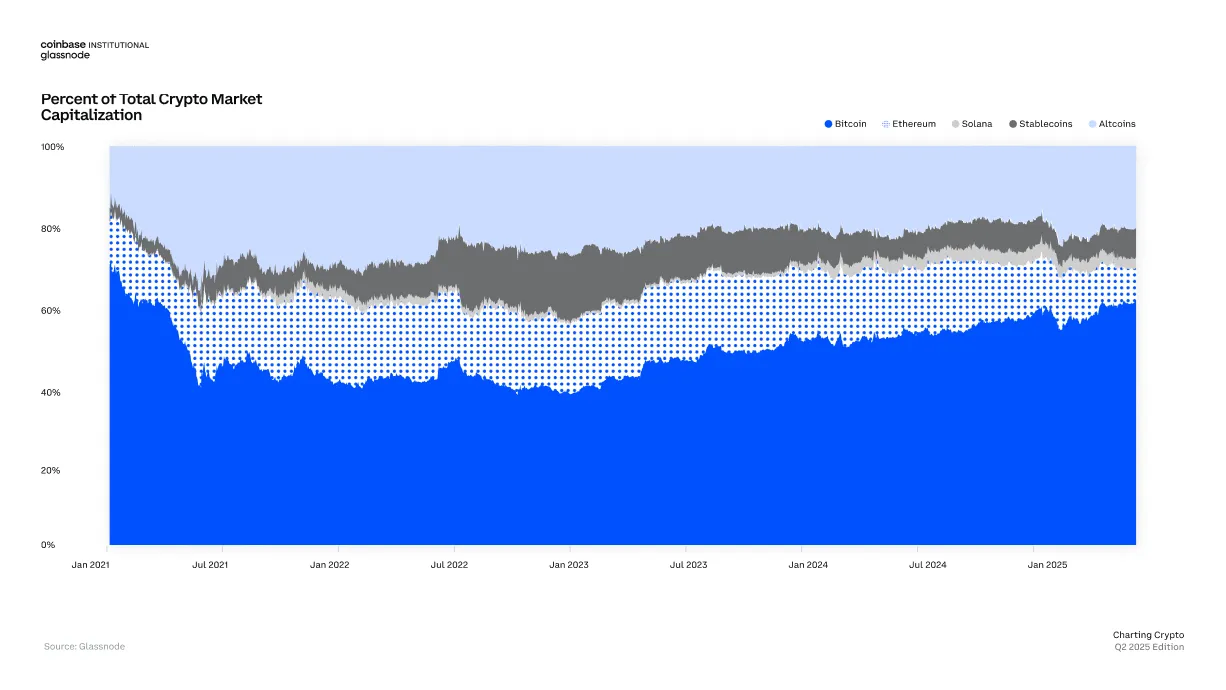
 Bitcoin dominance rises to 63% , highest level since early 2021 as investors turn to high-trust assets

During times of turmoil, capital moves to perceived quality assets — and Bitcoin benefits from this. Bitcoin currently accounts for 63% of the total crypto market cap, its highest level since early 2021. Meanwhile, Ethereum’s share of the total cryptocurrency market cap has shrunk over the past six months, while Solana’s share has remained stable since early 2024.

Bitcoin's dominance reflects investors' preference for assets with the highest institutional accessibility and macro correlation. Despite the price drop, long-term Bitcoin holders are still accumulating, as evidenced by the reduction in liquidity supply and the sharp rise in the number of Bitcoins held at a loss, indicating renewed confidence among strategic allocators.

Cash ETFs remain critical to market structure
Q2 Market Insights: Bitcoin regains dominance in risk-averse environment, ETFs remain critical to market structure

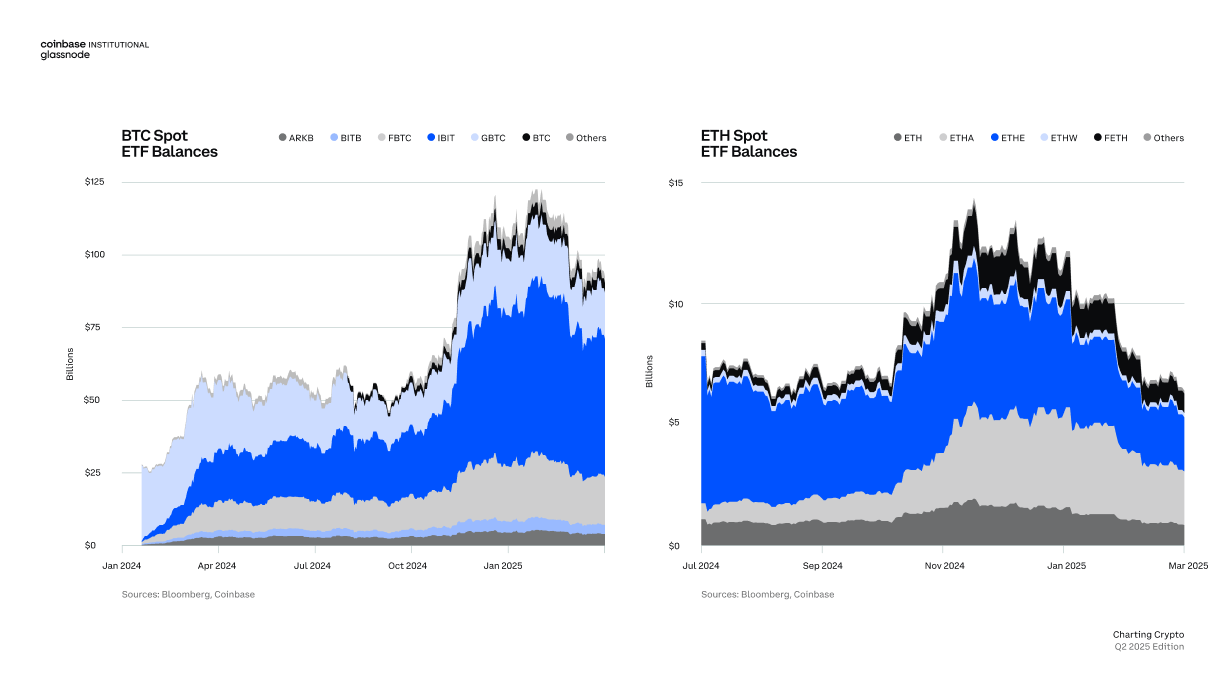
 Despite recent outflows, Bitcoin and Ethereum ETFs maintain sizeable holdings, indicating continued institutional interest

ETF flows remain a key indicator of institutional investor sentiment. In the first quarter, inflows into Bitcoin and Ethereum spot ETFs were subdued but continued, with total Bitcoin ETF balances approaching $125 billion. Although funding rates in the futures market have fallen, indicating a weakening of speculative appetite, spot ETF activity reflects long-term positioning.
Q2 Market Insights: Bitcoin regains dominance in risk-averse environment, ETFs remain critical to market structure

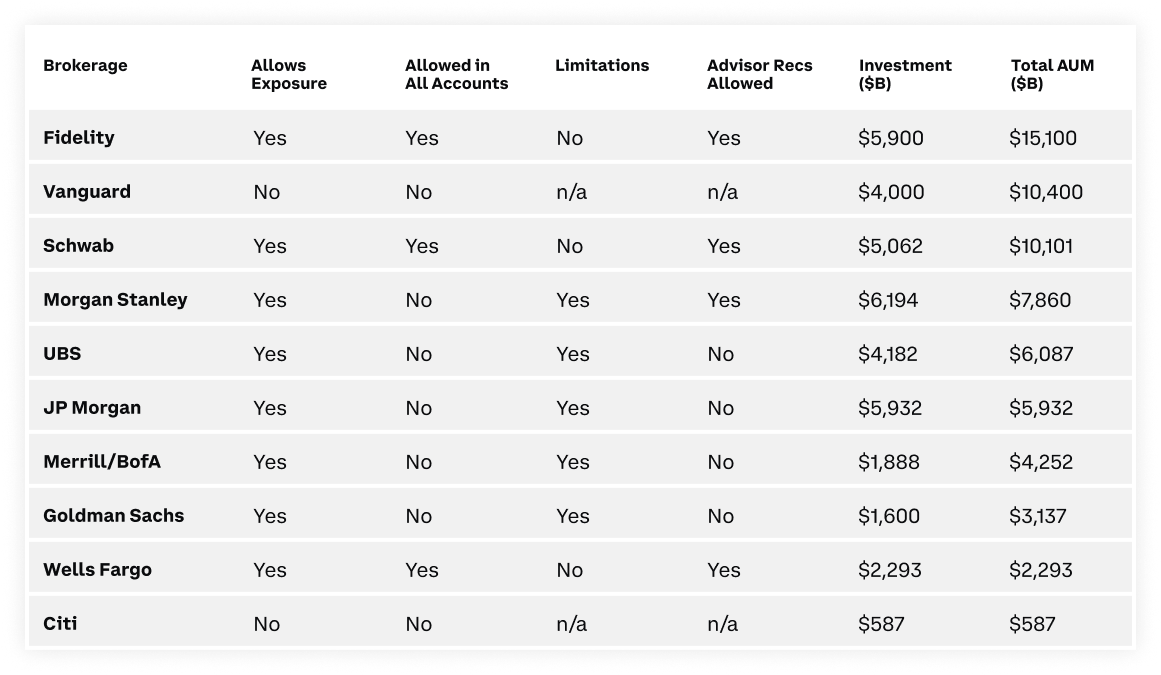
 Large brokerages are still limiting clients’ investments in Bitcoin ETFs . If these platforms set a 2% Bitcoin allocation, it would mean that ETF net inflows would be 22 times that of 2024.

Notably, investment restrictions by large brokerages hint at a potential wave of demand if entry restrictions are relaxed.

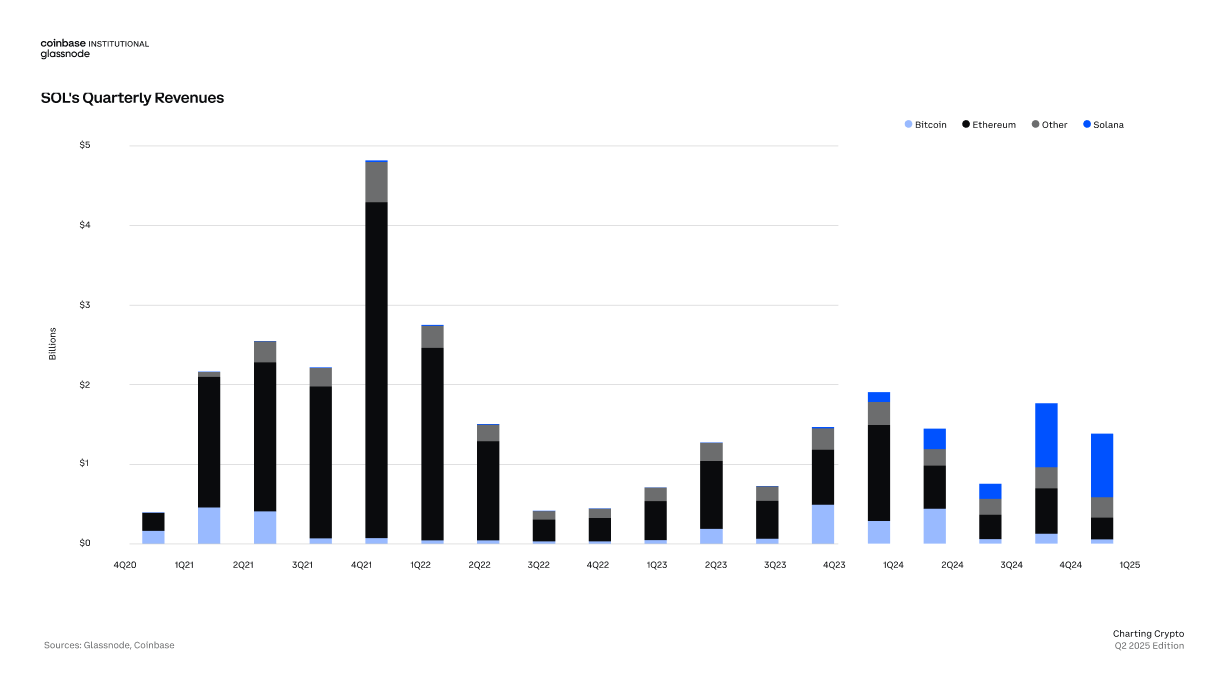
Solana revenue exceeds all other L1 and L2 platforms
Q2 Market Insights: Bitcoin regains dominance in risk-averse environment, ETFs remain critical to market structure

Solana surpassed all other blockchains in the first quarter, with revenue exceeding that of Bitcoin, Ethereum, and other blockchains combined.

Despite the macroeconomic shocks facing the market and the turbulent negative discussions around memecoin, Solana's revenue in the first quarter still exceeded the sum of all other L1 and L2 networks. This revenue highlights the continued stickiness of ecosystem users and shows that the capital efficiency and developer activity of the Solana ecosystem remain strong.

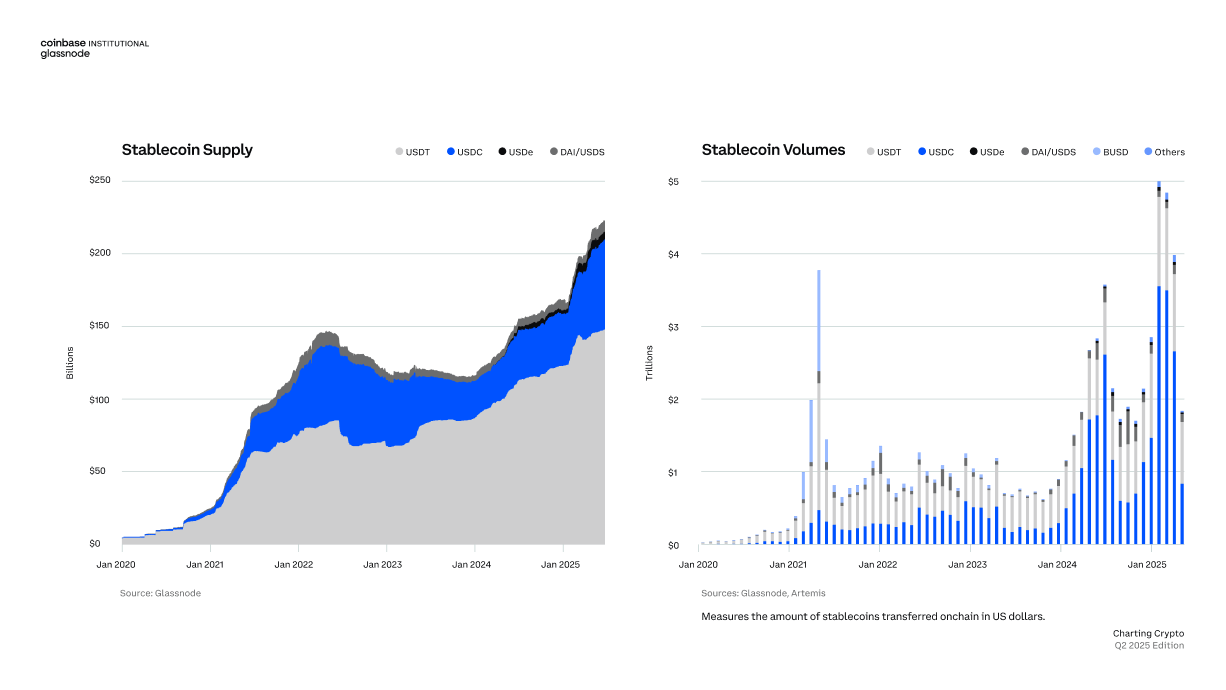
Stablecoins solidify their place as the backbone of crypto finance
Q2 Market Insights: Bitcoin regains dominance in risk-averse environment, ETFs remain critical to market structure

Stablecoin supply and on-chain transaction volume hit record highs, highlighting their increasingly important role in global digital payments.

As a core component of the crypto-financial system, stablecoins continue to attract attention. Adjusted for inactive transactions, stablecoin trading volume hit an all-time high last quarter. With falling fees and expanding use cases (from remittances to corporate payments), stablecoins are expected to attract more institutional and retail investors in 2025, especially in high-inflation economies.

Conclusion

The report believes that the crypto market may bottom out in the middle and late second quarter of 2025, laying the foundation for the trend in the third quarter of 2025. Overall, the market will show a downward trend in the short term, and then rebound and set a new high in the second half of the year. However, if the following factors occur, the above view will be invalid:

If the Fed ends quantitative tightening, it will increase global liquidity and support the crypto market. Similarly, if major economies such as the EU or China introduce more global fiscal stimulus, it may increase the M2 money supply and push up the capital available in the market.

More worryingly, further uncertainty over the trade war could prolong negative market sentiment, while global shocks could further reduce liquidity.

Related reading: Cryptocurrency Industry Report for the First Quarter of 2025: DeFi and NFT Ecosystem Trends, CEX and DEX Market Performance


Sorumluluk Reddi: Bu sitede yeniden yayınlanan makaleler, halka açık platformlardan alınmıştır ve yalnızca bilgilendirme amaçlıdır. MEXC'nin görüşlerini yansıtmayabilir. Tüm hakları telif sahiplerine aittir. Herhangi bir içeriğin üçüncü taraf haklarını ihlal ettiğini düşünüyorsanız, kaldırılması için lütfen service@support.mexc.com ile iletişime geçin. MEXC, içeriğin doğruluğu, eksiksizliği veya güncelliği konusunda hiçbir garanti vermez ve sağlanan bilgilere dayalı olarak alınan herhangi bir eylemden sorumlu değildir. İçerik, finansal, yasal veya diğer profesyonel tavsiye niteliğinde değildir ve MEXC tarafından bir tavsiye veya onay olarak değerlendirilmemelidir.

Ayrıca Şunları da Beğenebilirsiniz

The Channel Factories We’ve Been Waiting For

The Channel Factories We’ve Been Waiting For

The post The Channel Factories We’ve Been Waiting For appeared on BitcoinEthereumNews.com. Visions of future technology are often prescient about the broad strokes while flubbing the details. The tablets in “2001: A Space Odyssey” do indeed look like iPads, but you never see the astronauts paying for subscriptions or wasting hours on Candy Crush.  Channel factories are one vision that arose early in the history of the Lightning Network to address some challenges that Lightning has faced from the beginning. Despite having grown to become Bitcoin’s most successful layer-2 scaling solution, with instant and low-fee payments, Lightning’s scale is limited by its reliance on payment channels. Although Lightning shifts most transactions off-chain, each payment channel still requires an on-chain transaction to open and (usually) another to close. As adoption grows, pressure on the blockchain grows with it. The need for a more scalable approach to managing channels is clear. Channel factories were supposed to meet this need, but where are they? In 2025, subnetworks are emerging that revive the impetus of channel factories with some new details that vastly increase their potential. They are natively interoperable with Lightning and achieve greater scale by allowing a group of participants to open a shared multisig UTXO and create multiple bilateral channels, which reduces the number of on-chain transactions and improves capital efficiency. Achieving greater scale by reducing complexity, Ark and Spark perform the same function as traditional channel factories with new designs and additional capabilities based on shared UTXOs.  Channel Factories 101 Channel factories have been around since the inception of Lightning. A factory is a multiparty contract where multiple users (not just two, as in a Dryja-Poon channel) cooperatively lock funds in a single multisig UTXO. They can open, close and update channels off-chain without updating the blockchain for each operation. Only when participants leave or the factory dissolves is an on-chain transaction…
Paylaş
BitcoinEthereumNews2025/09/18 00:09
XRP Price Prediction: Can Ripple Rally Past $2 Before the End of 2025?

XRP Price Prediction: Can Ripple Rally Past $2 Before the End of 2025?

The post XRP Price Prediction: Can Ripple Rally Past $2 Before the End of 2025? appeared first on Coinpedia Fintech News The XRP price has come under enormous pressure
Paylaş
CoinPedia2025/12/16 19:22
BlackRock boosts AI and US equity exposure in $185 billion models

BlackRock boosts AI and US equity exposure in $185 billion models

The post BlackRock boosts AI and US equity exposure in $185 billion models appeared on BitcoinEthereumNews.com. BlackRock is steering $185 billion worth of model portfolios deeper into US stocks and artificial intelligence. The decision came this week as the asset manager adjusted its entire model suite, increasing its equity allocation and dumping exposure to international developed markets. The firm now sits 2% overweight on stocks, after money moved between several of its biggest exchange-traded funds. This wasn’t a slow shuffle. Billions flowed across multiple ETFs on Tuesday as BlackRock executed the realignment. The iShares S&P 100 ETF (OEF) alone brought in $3.4 billion, the largest single-day haul in its history. The iShares Core S&P 500 ETF (IVV) collected $2.3 billion, while the iShares US Equity Factor Rotation Active ETF (DYNF) added nearly $2 billion. The rebalancing triggered swift inflows and outflows that realigned investor exposure on the back of performance data and macroeconomic outlooks. BlackRock raises equities on strong US earnings The model updates come as BlackRock backs the rally in American stocks, fueled by strong earnings and optimism around rate cuts. In an investment letter obtained by Bloomberg, the firm said US companies have delivered 11% earnings growth since the third quarter of 2024. Meanwhile, earnings across other developed markets barely touched 2%. That gap helped push the decision to drop international holdings in favor of American ones. Michael Gates, lead portfolio manager for BlackRock’s Target Allocation ETF model portfolio suite, said the US market is the only one showing consistency in sales growth, profit delivery, and revisions in analyst forecasts. “The US equity market continues to stand alone in terms of earnings delivery, sales growth and sustainable trends in analyst estimates and revisions,” Michael wrote. He added that non-US developed markets lagged far behind, especially when it came to sales. This week’s changes reflect that position. The move was made ahead of the Federal…
Paylaş
BitcoinEthereumNews2025/09/18 01:44


