

How to file tax on the LIRS eTax portal: A step-by-step guide for Lagos residents
Table of contents
Why was the deadline moved to April 14?
What counts as “income” under the Nigeria Tax Act 2025?
Who needs to file taxes in Lagos?
What you need before you start filing on the LIRS eTax portal
How to file taxes on the LIRS eTax portal: Step by step
Penalties for not filing your tax return by April 14
What happens after you file? Getting your Tax Clearance Certificate
Frequently asked questions about filing taxes on the LIRS eTax portal
What Nigeria’s 2025 tax reform changed
If you have been trying to figure out how to file taxes in Lagos, this guide covers everything you need. The Lagos State Internal Revenue Service (LIRS) eTax portal at etax.lirs.net is the only approved platform for filing your annual personal income tax return, with a deadline of April 14, 2026. Every Lagos resident earning income must file, including salaried employees. Even if your company deducts PAYE from your salary every month and remits it to the government, you are still legally required to file your own individual return. Your employer’s payment does not cover your filing obligation. This is the first filing season under Nigeria’s sweeping 2025 tax reform laws, which introduced new tax bands, abolished the old Consolidated Relief Allowance, and made electronic filing the only acceptable method.
Below is everything you need to know, from required documents and step-by-step portal navigation to exact penalty figures and post-filing steps.
Why was the deadline moved to April 14?
On March 31, 2026, LIRS Executive Chairman, Dr Ayodele Subair, announced a two-week extension of the individual annual income tax return deadline, pushing it from the statutory March 31 to April 14, 2026.
The press statement, signed by Head of Corporate Communications, Monsurat Amasa-Oyelude, described it as a one-off measure to ease compliance and give taxpayers additional time to complete and submit accurate tax returns.
The official statement did not mention portal problems. But Technext broke a story on March 30: the LIRS eTax portal at etax.lirs.net had experienced widespread technical difficulties just one day before the original deadline. Users reported hours of failed access attempts, submission errors, and an inability to complete filings. One user noted: “This is what’s expected of a platform likely designed for a few thousand users per day, suddenly needed to be accessed by millions.” Since manual filing has been completely phased out, taxpayers had no alternative.
This was not an isolated event. Earlier in 2026, LIRS also extended the employer annual returns deadline from February 1 to February 7, signalling a pattern of administrative flexibility under the new tax regime.
LIRS described the extension as a one-off measure. After April 14, penalties under the Nigeria Tax Administration Act (NTAA) 2025 kick in: N100,000 for the first month of default, plus N50,000 for each subsequent month.
What counts as “income” under the Nigeria Tax Act 2025?
The NTA 2025 defines ‘income’ broadly. Section 4 of the Act spells out every category of income, profits, or gains that are chargeable to tax. The law does not limit income to your salary or your business profit. It captures almost every way money can come to you.
Here is what counts as taxable income:
- Employment income — your salary, wages, fees, allowances, bonuses, commissions, gratuity, and any other benefit your employer gives you, including things like a company car or rent-free accommodation
- Business and trade income — profit from any trade, business, or commercial activity. This includes selling perfume from home, baking and selling food, running a logistics operation from your phone, or any buying-and-selling activity, no matter how small
- Professional income — fees earned from professional services. This applies to lawyers, doctors, consultants, photographers, makeup artists, event planners, and any person who earns money by rendering a service
- Investment income — interest from savings accounts, dividends from shares, rent collected from property you own, and royalties
- Digital and virtual asset gains — profit from buying and selling crypto, NFTs, or any other digital asset
- Other sources — prizes, winnings, honoraria, grants, awards, discounts, rebates, and income from selling personal property or fixed assets
The threshold is N800,000 per year. If your total income from all the sources above is N800,000 or less annually, your tax is 0%. But you are still required to file a return.
Who needs to file taxes in Lagos?
One of the biggest misconceptions in Nigerian tax compliance is the belief that salaried employees whose employers deduct Pay-As-You-Earn (PAYE) tax do not need to file annual returns. This is wrong. Section 14(3) of the NTAA 2025 explicitly resolves a long-standing ambiguity in the old Personal Income Tax Act: employees must file their own annual returns of income from all sources, notwithstanding the employer’s separate filing obligation under Section 14(1)-(2).
LIRS has stated this directly: “Filing annual tax returns is not optional; it is a legal requirement under the NTAA 2025. While many employees believe their tax obligations end with PAYE deductions by employers, the LIRS clarifies that individuals must still file returns.” Taiwo Oyedele, Minister of State for Finance and Chairman of the Presidential Fiscal Policy and Tax Reforms Committee, reinforced the point, noting that “the tax reforms clarify that employees cannot assume their obligations end once employers deduct taxes from their salaries.”
Here are the categories of people legally required to file taxes in Lagos, under Section 13 of the NTAA 2025:
- Salaried/PAYE employees – Even if your employer already files PAYE returns and deducts tax monthly, you must file an individual annual return declaring all income sources. This includes your salary, any side businesses, freelance work, rental income, and dividends.
- Self-employed individuals, freelancers, and gig workers – This includes digital creators, consultants, and anyone earning from online platforms. The NTA 2025 expressly brings digital/virtual asset gains, prizes, honoraria, and nontraditional income into the tax net.
- Business owners – Sole proprietors file as individuals under personal income tax. Partnerships are addressed under Section 15 of the NTA 2025.
- Professionals – Lawyers, doctors, accountants, engineers, and others in professional practice. Professional services firms are specifically excluded from the small business CIT exemption regardless of turnover.
- Informal sector workers – Market traders, artisans, and small business operators. Section 15 of the NTAA 2025 allows simplified returns for low-income earners. A 1% presumptive tax on annual turnover applies to businesses without formal records.
Even individuals with income below the taxable threshold can submit a nil return. The filing obligation is universal; only the tax liability may be zero.
What you need before you start filing on the LIRS eTax portal
Gather these documents and information before logging onto the eTax portal. Missing items will stall the process.
- Your Tax Identification Number (TIN): This is the most critical requirement. LIRS assigns this as a “Payer ID” starting with an “N-” prefix. If you don’t have one, you can register directly on etax.lirs.net. If you have been on an employer’s payroll, your HR department may already have your TIN. You can also verify whether you have one through the Joint Tax Board’s TIN portal at tin.jtb.gov.ng using your NIN.
- BVN or NIN: You need either your Bank Verification Number or National Identification Number to register on the eTax portal. Only one is required.
- Income records from all sources for January to December 2025: This includes salary/wages, commissions, trade or business income, allowances, pension income, interest from savings and investments, rental income, dividends, foreign income, gratuities, and income from digital platforms or freelance work.
- H1 Form / Form A from your employer: Form H1 is filed by employers with LIRS, showing annual income and PAYE deductions for each employee. Form A is the individual’s return of income and claims for reliefs. Before filing, check “Employer Filed Returns” on your eTax dashboard to verify what your employer has reported for you.
- Supporting documents: Payslips, bank statements (especially for self-employed individuals), financial statements (for business owners), rent receipts (if claiming rent relief), evidence of pension contributions, evidence of NHF contributions, NHIS contribution records, life insurance premium receipts, and a recent passport photograph. The photo is required for your profile and for generating a Tax Clearance Certificate later.
- Reliefs and deductions you can claim under the NTA 2025: The N800,000 tax-free threshold (built into the 0% band), rent relief of 20% of annual rent paid up to N500,000, pension contributions (employee’s 8%), National Housing Fund contributions (2.5% of basic salary), NHIS contributions, life insurance premiums, and interest on housing loans for owner-occupied residences. Note that the old Consolidated Relief Allowance (N200,000 + 20% of gross income) has been abolished.
See the full list of 50 tax exemptions and reliefs under the new law.
How to file taxes on the LIRS eTax portal: Step by step
1. Step 1: Create an account on the LIRS eTax portal (new users)
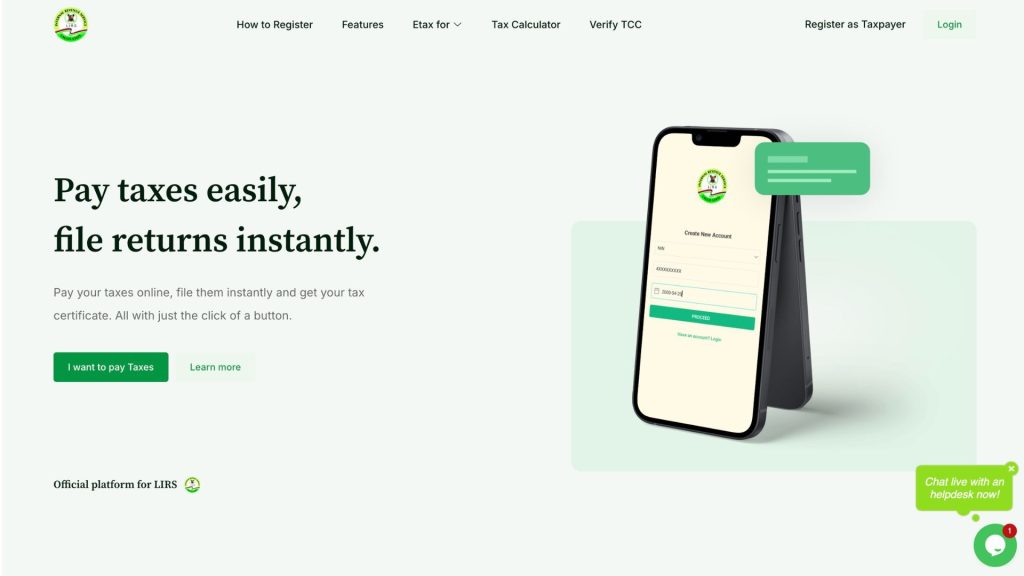
Go to https://etax.lirs.net in your browser. Click “Register as Taxpayer” in the top right corner of the homepage. On the registration form, select “Individual” from the Select Tax Payer Type dropdown, then choose your Identification System Type (BVN or NIN), enter the number and your date of birth, check the reCAPTCHA box, and click “Proceed.”
On the next page, fill in your personal details: title, name, email, phone number, occupation, marital status, nationality, gender, full address (street name, number, state, LCDA, and LGA), and select your nearest Tax Station from the dropdown. If asked whether you are a public servant, select accordingly. Choosing “No” lets you search for your business type and enter your occupation.
Click “Submit.” Your Taxpayer ID will be sent to your email along with a prompt to set a password. On the password setup page, enter your Taxpayer ID, click “Proceed,” enter the 6-digit OTP sent to your email, and create a password. The password must include at least one capital letter, one number, and a special character (such as # or @). Click “Proceed” to finish. If you already have an account, click “Already Have an Account? Login Here” instead.
2. Step 2: Log in to the LIRS eTax portal (existing users)
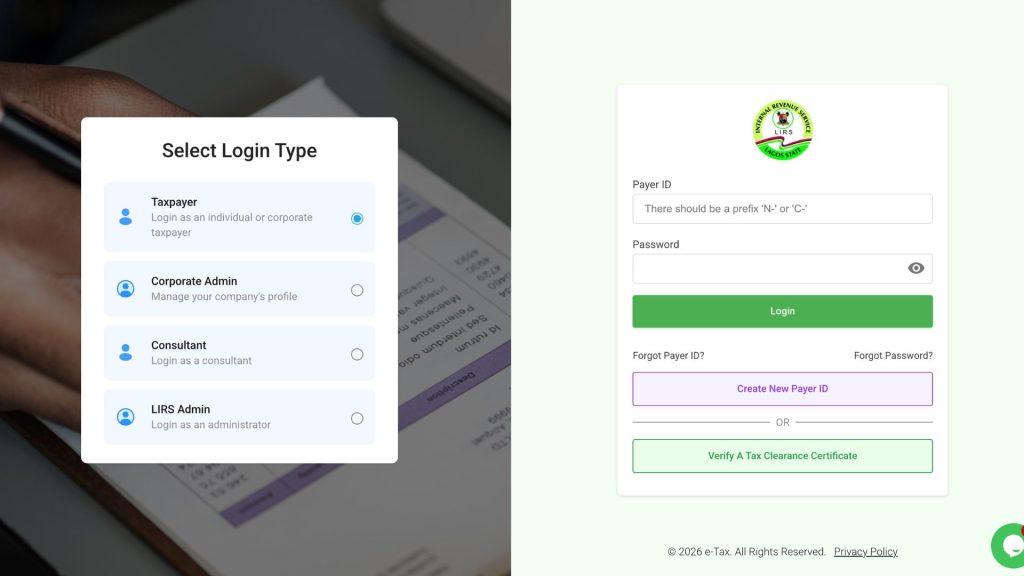
Go to etax.lirs.net. You will see a “Select Login Type” screen with four options: Taxpayer, Corporate Admin, Consultant, and LIRS Admin. Select “Taxpayer”; this is the option for individuals and corporate taxpayers. On the login form, enter your Payer ID in the field marked “There should be a prefix ‘N-‘ or ‘C-‘” and enter your password, then click the green “Login” button. If you forgot your Payer ID, click “Forgot Payer ID?” If you forgot your password, click “Forgot Password?” Both options are on the login form. If you are registering for the first time, click “Create New Payer ID” instead.
3. Step 3: Update your profile before filing
After logging in, verify your profile is complete. Check that your address, phone number, email, and passport photograph are all up to date. The photo is required to generate a Tax Clearance Certificate. If anything is missing, use the Chat Box in the bottom-right corner of the screen for help. You can also add family details (spouse and children’s Taxpayer IDs) by clicking “FAMILY RELATIONS” on the green bar at the bottom of your profile page.
4. Step 4: Check what your employer has already reported
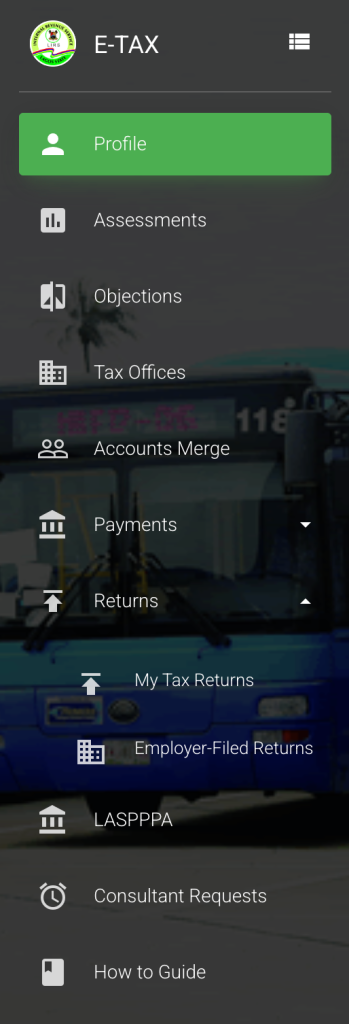
Click “RETURNS” on the left-side dashboard menu, then click “EMPLOYER FILED RETURNS.” Verify that returns for at least three years are displayed (2023, 2024, and 2025 for the current TCC cycle). Write down your gross income for each year. If any year is missing, contact your employer’s Human Resources department immediately.
5. Step 5: File your annual tax return
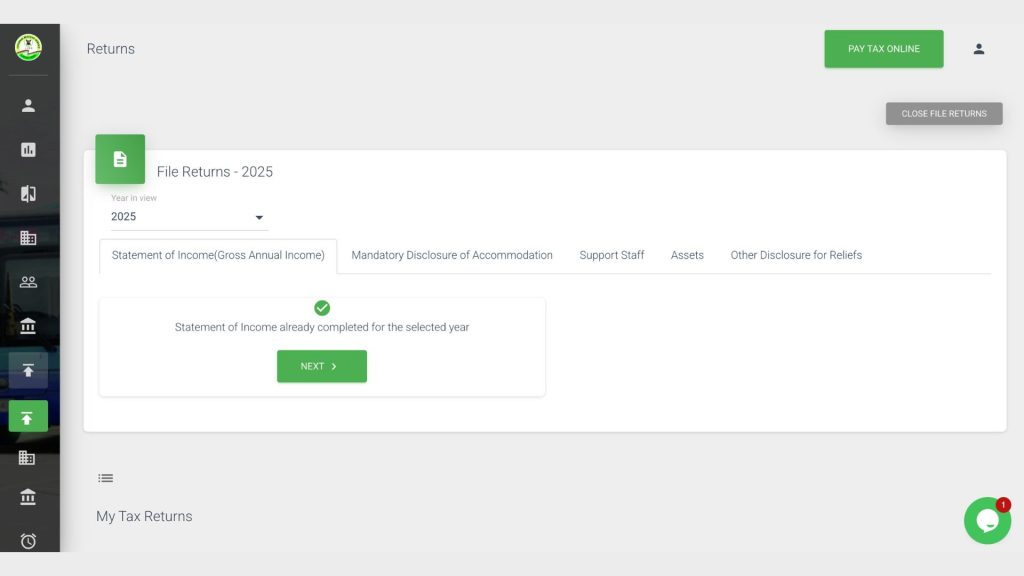
Click “RETURNS” on the dashboard, then “MY TAX RETURNS,” then click the “FILE RETURNS HERE” button in the top right corner. Select the Assessment Year. Choose 2025 for the current filing, or start with the earliest year if you need to file multiple years.
On the Statement of Income page, fill in all applicable income fields: employer name, salary, commission, trade/business income, allowances, pension income, interest, rent received, dividends, and foreign income. Scroll down and click “NEXT.”
The next page requires Mandatory Disclosure of Accommodation. Enter your residential address, accommodation type (rent or self-owned), and ownership type (tenant or owner). Provide rent amounts and landlord details if applicable. Click “NEXT.”
On the Other Disclosure for Reliefs page, enter claims for life assurance premiums, NHF contributions, gratuities received, NHIS contributions, and pension contributions (typically 8% of annual income for employees). Upload supporting documents where required. Click “FILE RETURNS” (or “SUBMIT”) to complete the filing.
If you need to file for multiple years, repeat the process for each additional year (2023, 2024) before requesting TCC approval.
6. Step 6: Request approval after submission
Use the Chat Box in the bottom-right corner of the screen to request approval for your submissions. LIRS will review and raise tax assessments based on your returns. If tax is owed beyond what PAYE has already covered, you can pay through the portal’s in-app payment channels or generate a Bill Reference and pay at any Lagos State Government-designated revenue-collecting bank. For the full list of accepted banks, visit the LIRS FAQ or call 0700-CALL-LIRS (0700-2255-5477).
Don’t agree with your tax bill? Nigeria’s new law gives you 30 days to object
Penalties for not filing your tax return by April 14
The NTAA 2025 replaced the old criminal penalties for filing failures with administrative penalties, but the financial consequences remain serious.
Section 101 of the NTAA 2025 imposes a penalty of N100,000 for the first month of default and N50,000 for each subsequent month the failure continues. These penalties apply whether you owe additional tax or not. Even failing to file a nil return triggers them.
If you file late but still file, you face the progressive monthly penalties plus 10% of any unpaid tax as a late payment surcharge, plus interest at the prevailing CBN Monetary Policy Rate (which has been in the 18-27% range in recent years) on any outstanding amount.
If you do not file at all, the consequences escalate further. Beyond the monthly penalties, LIRS can:
- Issue an Administrative Assessment under Section 34 of the NTAA 2025, where they estimate your tax liability using whatever information is available. If you do not formally object within 30 days of receiving it, the assessed amount becomes legally binding, even if it is higher than what you actually owe.
- Appoint your bank as a recovery agent to deduct the amount directly from your account.
- Assign the debt to third-party collectors under Section 68.
- Seize and sell assets (goods, property, bonds) under Section 61.
On January 21, 2026, LIRS issued seven Public Notices signalling active enforcement of these NTAA powers, including bank account recovery and property distraint.
Other penalties in the NTAA framework include:
- N50,000 plus N25,000/month for failure to register for a TIN (Section 100)
- N10,000 for individuals who fail to maintain books and records (Section 102)
- Criminal penalties of up to N20 million plus N2 million per day for failure to comply with a notice from the tax authority (Section 130)
What happens after you file? Getting your Tax Clearance Certificate
The Tax Clearance Certificate (TCC) is the practical payoff of filing your tax return. Under Section 72(2) of the NTAA 2025, it is required for an expanding list of transactions:
- Government contracts
- Business registration with the Corporate Affairs Commission
- Building plan approvals
- Foreign exchange transactions (including Personal Travel Allowance (PTA), Business Travel Allowance (BTA), and international school fees)
- Certificates of occupancy
- Government loans
- Motor vehicle registration
- Trade licences and public appointments
- Free West African Senior School Certificate Examination (WASSCE) registration for your children in Lagos (parents’ TCC is now required)
LIRS now issues an electronic TCC (eTCC) with a unique Certificate Number and scannable QR Code. To generate it, six conditions must be met:
- You have filed annual returns for the last three years (both employer-filed and individual-filed)
- You have uploaded a recent passport photograph to your eTax profile
- You have updated your full address
- You have received tax assessments for the last three years
- You have fully paid all taxes due
- You have completed your profile
Once all conditions are met, log in to etax.lirs.net and navigate to the “DOWNLOAD TCC” icon on the green bar after the profile section (or click “TCC” on the green bar). You will see a TCC Checklist page showing whether all conditions are satisfied. If everything checks out, you will be directed to a TCC Preview page displaying your photo, employer details, occupation, total income, tax paid, certificate number, and QR code. Click the download icon to get a soft copy, or print for a hard copy.
The process is automated. If all conditions are met, you can generate the eTCC instantly. The statutory timeline is two weeks from the date of demand, but the digital system often delivers same-day results.
To verify any TCC’s authenticity, scan the QR code or enter the Certificate Number at https://etax.lirs.net/tccverification/.
Frequently asked questions about filing taxes on the LIRS eTax portal
1) Do PAYE workers really need to file taxes in Lagos?
Yes. Section 14(3) of the NTAA 2025 makes this unambiguous. PAYE is a withholding mechanism, not a substitute for filing. Your employer can only report the income they pay you. You must declare all income from all sources, verify that your PAYE deductions were accurate, and obtain your TCC.
2) What if I have multiple income sources?
You must declare every source in a single annual return on the eTax portal. This includes salary, freelance fees, business profits, rental income, dividends, interest, digital asset gains, and foreign income. Each income type has a dedicated field.
3) How do I get a TIN if I do not have one?
Register on etax.lirs.net using either your BVN or NIN. Your Taxpayer ID (starting with “N-“) will be emailed to you. You can also check whether a TIN has been previously assigned through tin.jtb.gov.ng.
4) What if I have never filed taxes before?
Register on the LIRS eTax portal immediately and begin filing. You may need to file returns for multiple prior years to qualify for a TCC (which requires three years of filed returns). LIRS treats voluntary disclosure more favourably than catching non-compliance through enforcement.
5) What if I missed the April 14 deadline?
File as soon as possible. The monthly penalties of N100,000 for the first month and N50,000 for each subsequent month accrue from the day after the deadline. Filing late is significantly better than not filing at all. Non-filers risk Administrative Assessments that become binding if not challenged within 30 days, as well as direct recovery from bank accounts.
6) Is there a penalty for first-time non-filers?
Yes. The same penalty structure applies regardless of whether it is your first time. However, LIRS has historically prioritised bringing people into the tax net through education before strict enforcement.
7) What if the LIRS eTax portal goes down again?
LIRS describes the eTax platform as available 24/7, but the March 30 outage proved otherwise. If you encounter issues, try again during off-peak hours (early morning or late night). You can also call LIRS at 0700-CALL-LIRS (0700-2255-5477), email enquiries@lirs.gov.ng, or visit your nearest LIRS office for in-person assistance with the electronic process. Manual/paper filing is not an option; all returns must go through the portal.
8) Can I file taxes at an LIRS office?
Paper filing is completely phased out. But you can visit any LIRS office for guidance and help navigating the portal.
9) What about informal sector workers?
Market traders, artisans, and small business operators are expected to comply. A 1% presumptive tax on annual turnover applies to businesses without formal records. Lagos has historically taxed informal workers through trade unions, with a minimum annual tax of approximately N8,100. Cash collection by tax officials is banned under the new law; all payments must go through digital or official channels.
What Nigeria’s 2025 tax reform changed
On June 26, 2025, President Bola Tinubu signed four landmark tax bills into law, effective January 1, 2026: the Nigeria Tax Act (NTA), the Nigeria Tax Administration Act (NTAA), the Nigeria Revenue Service Establishment Act, and the Joint Revenue Board Establishment Act. This is the most comprehensive tax overhaul since independence, consolidating the Personal Income Tax Act, Companies Income Tax Act, Capital Gains Tax Act, VAT Act, and several other statutes into a unified framework.
For individual taxpayers, the most significant change is the new progressive tax rate structure:
- 0% on the first N800,000 of taxable income (effectively taking minimum wage earners out of the tax net)
- 15% on income from N800,001 to N3 million
- 18% on income from N3 million to N12 million
- 21% on income from N12 million to N25 million
- 23% on income from N25 million to N50 million
- 25% on income above N50 million (up from the previous 24%)
According to KPMG, one of the world’s leading professional services firms, most workers earning between N1.5 million and N25 million annually should see their net pay increase.
Other key changes include:
- The Consolidated Relief Allowance is gone. The old CRA of N200,000 plus 20% of gross income has been replaced by a Rent Relief of 20% of annual rent paid, capped at N500,000. Homeowners who do not pay rent lose this deduction entirely and rely solely on the 0% band.
- Capital gains are now taxed at the applicable progressive PIT rate rather than the old flat 10%.
- Gratuities and pension income are now taxable.
- Digital and virtual asset gains, prizes, honoraria, and grants are expressly included in taxable income for the first time.
- The NTAA replaced criminal penalties for filing failures with administrative ones (the N100,000/N50,000 monthly structure).
- A Tax Ombudsman has been established to resolve disputes, alongside powerful enforcement tools such as bank account recovery and asset seizure.
LIRS’s 2026 revenue target of N2.83 trillion, more than double recent collections, signals aggressive enforcement ahead. As CITN President Innocent Ohagwa put it: “Filing tax returns is a constitutional requirement, not a suggestion. Compliance is not just about revenue; it is about gaining the right to demand better governance.”
Read more:
- Remote workers in Nigeria to pay 23% income tax from 2026
- Why freelancers and influencers are now on Nigeria’s tax radar
- How freelancers can fight unfair taxes in 2026


Ayrıca Şunları da Beğenebilirsiniz

Vacation plans implode across America as Trump massacres the economy

Top 3 Magnificent 7 Stocks to Buy: Alphabet (GOOGL), Microsoft (MSFT), and Amazon (AMZN) Lead the Pack



