On 6 March 2026, the Court of Appeal in Nairobi issued a landmark decision on the Computer Misuse and Cybercrimes Act (2018) (Act). The Court held that sectionsOn 6 March 2026, the Court of Appeal in Nairobi issued a landmark decision on the Computer Misuse and Cybercrimes Act (2018) (Act). The Court held that sections

Kenya’s appeal’s court upholds cybercrime law but strikes down ‘fake news’ offences

2026/03/17 19:10
Okuma süresi: 4 dk
Bu içerikle ilgili geri bildirim veya endişeleriniz için lütfen crypto.news@mexc.com üzerinden bizimle iletişime geçin.

On 6 March 2026, the Court of Appeal in Nairobi issued a landmark decision on the Computer Misuse and Cybercrimes Act (2018) (Act). The Court held that sections 22 and 23 of the Act – which criminalised publication of certain forms of ‘false’ information – are unconstitutional.

The Bloggers Association of Kenya (BAKE), backed by media and civil society groups including Article 19 East Africa, the Kenya Union of Journalists, and the Law Society of Kenya, argued that large portions of the Act violated fundamental rights, including freedom of expression, privacy, and fair trial protections.

The Attorney General, the Speaker of the National Assembly, the Inspector General of the National Police Service and the Director of Public Prosecutions defended the law.

With this decision, Kenya’s cybercrimes framework has been largely validated, but the Court drew a clear line – the government cannot use the law to silence speech or conduct unchecked surveillance. For Internet Service Providers (ISPs) and tech companies, this decision is both a compliance roadmap and a shield.

A declaration of unconstitutionality on cybercrime law

Section 22 of the Act criminalises intentional publication of false, misleading or fictitious data or misinformation with the intent that the data or information be considered or acted upon as authentic.

Section 23 of the Act makes it an offence to publish information that is false (in print, broadcast, data or over a computer system) that is calculated or results in panic, chaos or violence, or which is likely to discredit the reputation of any person.

BAKE argued that these provisions unjustifiably limited constitutional rights, including freedom of belief and opinion (Article 32), freedom of expression (Article 33) and media freedom (Article 34).

According to BAKE, section 23 also offended Article 24 of the Constitution which prescribes the extent to which a constitutional right may be limited. In sum, BAKE argued that the provisions as drafted were broad, vague and lacked specificity.

The Court found that sections 22 and 23 of the Act are broad, wide, untargeted and are likely to capture both the original publisher of content and individuals who simply forward information without knowing it is false.

The Court emphatically held that ‘in a world without universal truths or falsities, the offences may be difficult to prove’ and ‘what we may hold to be false today may turn out to be true tomorrow’.

The Court separately noted that section 13 of the National Cohesion and Integration Act (2008) already criminalised what sections 22 and 23 of the Act seek to criminalise (in this context, hate speech and negative ethnicity).

Key takeaways for ISPs and technology companies operating in Kenya:

  • Compliance obligations on data requests are confirmed: When served with lawful court orders for traffic or content data, ISPs and platform providers will be expected to comply. The good news is that the Court has emphasised that parties seeking such orders must meet a high threshold of specificity and proportionality.
  • The ‘fake news’ risk has reduced: With sections 22 and 23 declared unconstitutional, platforms and users no longer face criminal liability for publishing information the State considers ‘false’. This is significant for content moderation policies, as the threat of criminal sanctions can push platforms to over-moderate user speech to avoid liability. The ruling may therefore shift greater responsibility for addressing misinformation to platform policies rather than fear of state prosecution.
  • Domain name practices matter: Cybersquatting remains a criminal offence under the Act. Businesses involved in domain registration and management should ensure they have robust policies to prevent bad-faith domain registrations.
  • Surveillance and data requests remain lawful, but with guardrails: Sections 48, 50, 51, 52 and 53 of the Act, which accord state authorities the power to obtain court orders for real-time data collection, search, and seizure of digital evidence, were upheld. However, the Court sent a strong signal that these powers must be exercised with care. Surveillance orders must clearly specify the offence being investigated, the period of interception, and how the data will be examined, used, stored, and ultimately destroyed.

Read also: The Global Kenyan: How Diaspora Professionals Are Arbitraging 2026 Tech Salaries

The post Kenya’s appeal’s court upholds cybercrime law but strikes down ‘fake news’ offences appeared first on The Exchange Africa.


Piyasa Fırsatı
The AI Prophecy Logosu
The AI Prophecy Fiyatı(ACT)
$0.01137
$0.01137$0.01137
-4.61%
USD
The AI Prophecy (ACT) Canlı Fiyat Grafiği
Sorumluluk Reddi: Bu sitede yeniden yayınlanan makaleler, halka açık platformlardan alınmıştır ve yalnızca bilgilendirme amaçlıdır. MEXC'nin görüşlerini yansıtmayabilir. Tüm hakları telif sahiplerine aittir. Herhangi bir içeriğin üçüncü taraf haklarını ihlal ettiğini düşünüyorsanız, kaldırılması için lütfen crypto.news@mexc.com ile iletişime geçin. MEXC, içeriğin doğruluğu, eksiksizliği veya güncelliği konusunda hiçbir garanti vermez ve sağlanan bilgilere dayalı olarak alınan herhangi bir eylemden sorumlu değildir. İçerik, finansal, yasal veya diğer profesyonel tavsiye niteliğinde değildir ve MEXC tarafından bir tavsiye veya onay olarak değerlendirilmemelidir.

Ayrıca Şunları da Beğenebilirsiniz

This week, NFT transaction volume rebounded by 1.27% to US$108.6 million, and the number of buyers and sellers increased by more than 50%.

This week, NFT transaction volume rebounded by 1.27% to US$108.6 million, and the number of buyers and sellers increased by more than 50%.

PANews reported on September 21st that Crypto.news reported that CryptoSlam data showed that NFT market transaction volume increased by 1.27% over the past week, reaching $108.6 million. Market participation has rebounded, with the number of NFT buyers increasing by 53.24% to 276,735 and the number of NFT sellers increasing by 67.19% to 206,669. However, the number of NFT transactions decreased by 6.65% to 1,630,579. Ethereum network transaction volume reached $46.7 million, a 42.85% surge from the previous week. Mythos Chain network transaction volume reached $12.15 million, down 21.91%. Bitcoin network transaction volume reached $9.82 million, down 2.17%. This week's high-value transactions include: BOOGLE sold for 1,380 SOL ($324,846 USD) CryptoPunks #8521 sold for 55.48 ETH ($255,288 USD) CryptoPunks #4420 sold for 56.388 ETH ($254,250) CryptoPunks #2642 sold for 52.1 ETH ($239,735) CryptoPunks #1180 sold for 49.89 ETH ($232,394)
Paylaş
PANews2025/09/21 09:01
XRP’s ‘True Value’ Could Be $32, Says BlackRock Executive
XRP’s ‘True Value’ Could Be $32, Says BlackRock Executive

Robert Mitchnick and Susan Athey’s 2018 study valued XRP up to $32 under adoption scenarios. Bitcoin is trading above the modeled fair value of $93,000 at $112,800, while XRP has remained stagnant around $3. A resurfaced research paper co-authored in 2018 by Robert Mitchnick, now Head of Digital Assets at BlackRock, has drawn fresh attention [...]]]>
Paylaş
Crypto News Flash2025/09/22 16:40
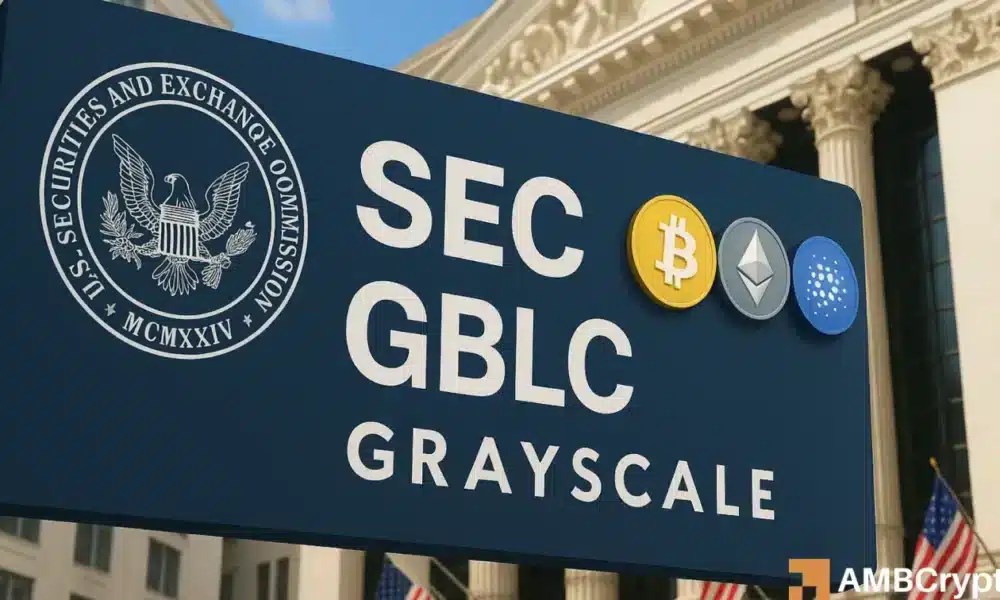
Grayscale’s ‘first multi-crypto asset ETP’ in the works: Will BTC, ETH win?

Grayscale’s ‘first multi-crypto asset ETP’ in the works: Will BTC, ETH win?

The post Grayscale’s ‘first multi-crypto asset ETP’ in the works: Will BTC, ETH win? appeared on BitcoinEthereumNews.com. Key Takeaways What does this approval mean for investors? It allows traditional investors to access diversified exposure to major cryptocurrencies without buying tokens directly. Which cryptocurrencies are included in GDLC? Bitcoin, Ether, XRP, Solana, and Cardano. The U.S. Securities and Exchange Commission (SEC) has greenlit the Grayscale Digital Large Cap Fund (GDLC) for stock exchange trading.  The approval, coinciding with relaxed ETF listing standards, opens the door for traditional investors to access the crypto market more easily and signals growing institutional support. Grayscale CEO Peter Mintzberg weighs in Grayscale CEO Peter Mintzberg confirmed the development on X (formerly Twitter), praising the SEC’s Crypto Task Force for providing much-needed clarity to the sector. He said,  “The Grayscale team is working expeditiously to bring the FIRST multi #crypto asset ETP to market with Bitcoin, Ethereum, XRP, Solana, and Cardano.” He further added,  “Thank you to the SEC #Crypto Task Force for their continued, unmatched efforts in bringing the regulatory clarity our industry deserves.” The newly approved Grayscale Digital Large Cap Fund (GDLC) offers investors exposure to five of the world’s largest cryptocurrencies: Bitcoin [BTC], Ethereum [ETH], Ripple [XRP], Solana [SOL], and Cardano [ADA]. Impact on included tokens Following the announcement, markets reacted positively. BTC traded at $117,153.61 after a 0.69% rise in the past 24 hours, Ether climbed 2.02% to $4,579.73, XRP at $3.10 up by 3.07%, Solana at $245.94 up by 4.78%, and Cardano reached $0.9130 up by 4.85%, per CoinMarketCap. By packaging multiple cryptocurrencies into a single ETP, GDLC allows traditional investors to gain diversified crypto exposure without the need to open exchange accounts or purchase individual tokens. This green light comes just months after the SEC had delayed Grayscale’s plan to convert GDLC from an over-the-counter fund to an ETP listed on NYSE Arca. With approval now granted, the fund is…
Paylaş
BitcoinEthereumNews2025/09/19 12:53

Trade GOLD, Share 1,000,000 USDT

Trade GOLD, Share 1,000,000 USDTTrade GOLD, Share 1,000,000 USDT

0 fees, up to 1,000x leverage, deep liquidity

