TLDR: Vision Chain is built on the OP Stack and designed to meet Europe’s MiCAR and MiFID II regulatory standards. Bitpanda removes the complexity of private blockchainTLDR: Vision Chain is built on the OP Stack and designed to meet Europe’s MiCAR and MiFID II regulatory standards. Bitpanda removes the complexity of private blockchain

Bitpanda, Vision Web3 Foundation, and Optimism Launch Vision Chain for European Institutional Finance

2026/03/26 06:15
Okuma süresi: 4 dk
Bu içerikle ilgili geri bildirim veya endişeleriniz için lütfen crypto.news@mexc.com üzerinden bizimle iletişime geçin.

TLDR:

  • Vision Chain is built on the OP Stack and designed to meet Europe’s MiCAR and MiFID II regulatory standards.
  • Bitpanda removes the complexity of private blockchain systems, helping institutions move from pilots to production.
  • The Vision Token (VSN) ties network revenue to token buybacks, linking ecosystem activity to long-term stability.
  • Bitpanda’s seven million users gain access to tokenized assets previously reserved for professional market participants.

Vision Chain has entered the market as a blockchain layer built for European financial institutions. Bitpanda, the Vision Web3 Foundation, and Optimism developed the network on the OP Stack.

It connects traditional finance to the global onchain economy. The chain operates within the EU’s MiCAR and MiFID II frameworks and aligns with DORA resilience principles.

This launch targets a critical gap that has left European institutions relying on closed, proprietary networks with limited liquidity.

Replacing Closed Networks With Open, Compliant Infrastructure

European financial institutions have long relied on closed, proprietary blockchain networks. These systems lack the liquidity and interoperability required for broader market participation.

Vision Chain offers a standardized, managed infrastructure as a replacement. Partners can move from isolated pilots to live production-grade deployments.

Vision announced the launch, noting Vision Chain merges Ethereum-level openness with a framework suited to Europe’s regulatory environment. The chain gives institutions a public blockchain they can practically use.

This design reflects growing institutional demand for compliant, interoperable access. The network is built to serve both regulated institutions and the broader DeFi sector.

Bitpanda removes the operational complexity of building private blockchain systems for partners. This lowers costs and shortens the path from pilot to production.

The network uses MiCA-compliant Euro stablecoins to settle all network and transaction fees. This removes the currency volatility that often comes with fees on public blockchains.

Bitpanda CEO Lukas Enzersdorfer-Konrad described the shift as a foundational moment for European capital markets. “Today, we still talk about digital assets, but in the future all assets will likely be digital,” he said.

He added that European financial institutions have been ready for this shift for years, but the infrastructure has been missing. Vision Chain, he noted, combines the openness of public networks with the reliability institutions require.

Vision Token Anchors the Network’s Economic Model

The Vision Token (VSN) forms the commercial backbone of Vision Chain’s ecosystem. Issued by the Vision Web3 Foundation, VSN is a crypto-asset tied to network activity.

A portion of revenue generated by the network goes toward buying and removing tokens from circulation. This creates a direct link between network usage and ecosystem stability.

The network also expands access for Bitpanda’s over seven million users. They gain entry to tokenized investment products once reserved for professional market participants.

Banks and fintechs can issue high-quality assets directly on the chain. DeFi developers can build compliant products using those institutional-grade assets.

Fabian Reinisch, President of the Vision Web3 Foundation Board, said the chain marks a key milestone for the foundation. “By aligning public blockchain technology with institutional requirements and long-term ecosystem incentives, we are laying the groundwork for a new generation of European financial applications,” he stated.

Vision Chain was built to align public blockchain technology with institutional needs. The aim is transparent, interoperable networks for European finance.

Optimism’s role centers on its OP Enterprise model, which handles chain operations and upgrades. CEO Jing Wang said the model lets partners focus on product development rather than infrastructure management.

“Vision Chain reflects the growing demand for blockchain infrastructure that meets institutional standards without sacrificing the openness of Ethereum,” Wang said. Together, the three organizations aim to strengthen Europe’s role in the global onchain economy.

The post Bitpanda, Vision Web3 Foundation, and Optimism Launch Vision Chain for European Institutional Finance appeared first on Blockonomi.


Piyasa Fırsatı
Vision Logosu
Vision Fiyatı(VSN)
$0.06135
$0.06135$0.06135
+13.69%
USD
Vision (VSN) Canlı Fiyat Grafiği
Sorumluluk Reddi: Bu sitede yeniden yayınlanan makaleler, halka açık platformlardan alınmıştır ve yalnızca bilgilendirme amaçlıdır. MEXC'nin görüşlerini yansıtmayabilir. Tüm hakları telif sahiplerine aittir. Herhangi bir içeriğin üçüncü taraf haklarını ihlal ettiğini düşünüyorsanız, kaldırılması için lütfen crypto.news@mexc.com ile iletişime geçin. MEXC, içeriğin doğruluğu, eksiksizliği veya güncelliği konusunda hiçbir garanti vermez ve sağlanan bilgilere dayalı olarak alınan herhangi bir eylemden sorumlu değildir. İçerik, finansal, yasal veya diğer profesyonel tavsiye niteliğinde değildir ve MEXC tarafından bir tavsiye veya onay olarak değerlendirilmemelidir.

Ayrıca Şunları da Beğenebilirsiniz

This week, NFT transaction volume rebounded by 1.27% to US$108.6 million, and the number of buyers and sellers increased by more than 50%.

This week, NFT transaction volume rebounded by 1.27% to US$108.6 million, and the number of buyers and sellers increased by more than 50%.

PANews reported on September 21st that Crypto.news reported that CryptoSlam data showed that NFT market transaction volume increased by 1.27% over the past week, reaching $108.6 million. Market participation has rebounded, with the number of NFT buyers increasing by 53.24% to 276,735 and the number of NFT sellers increasing by 67.19% to 206,669. However, the number of NFT transactions decreased by 6.65% to 1,630,579. Ethereum network transaction volume reached $46.7 million, a 42.85% surge from the previous week. Mythos Chain network transaction volume reached $12.15 million, down 21.91%. Bitcoin network transaction volume reached $9.82 million, down 2.17%. This week's high-value transactions include: BOOGLE sold for 1,380 SOL ($324,846 USD) CryptoPunks #8521 sold for 55.48 ETH ($255,288 USD) CryptoPunks #4420 sold for 56.388 ETH ($254,250) CryptoPunks #2642 sold for 52.1 ETH ($239,735) CryptoPunks #1180 sold for 49.89 ETH ($232,394)
Paylaş
PANews2025/09/21 09:01
XRP’s ‘True Value’ Could Be $32, Says BlackRock Executive
XRP’s ‘True Value’ Could Be $32, Says BlackRock Executive

Robert Mitchnick and Susan Athey’s 2018 study valued XRP up to $32 under adoption scenarios. Bitcoin is trading above the modeled fair value of $93,000 at $112,800, while XRP has remained stagnant around $3. A resurfaced research paper co-authored in 2018 by Robert Mitchnick, now Head of Digital Assets at BlackRock, has drawn fresh attention [...]]]>
Paylaş
Crypto News Flash2025/09/22 16:40
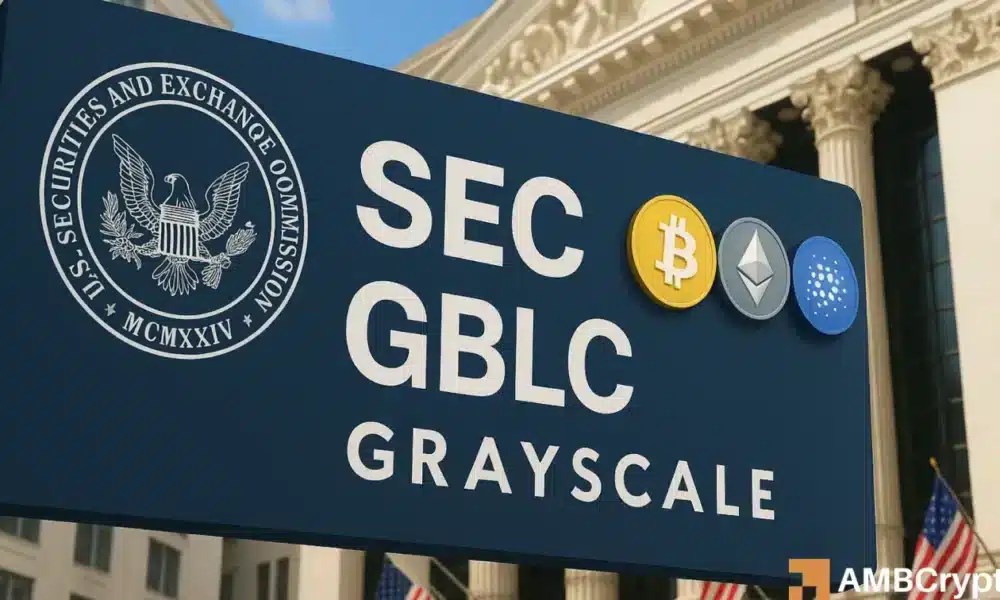
Grayscale’s ‘first multi-crypto asset ETP’ in the works: Will BTC, ETH win?

Grayscale’s ‘first multi-crypto asset ETP’ in the works: Will BTC, ETH win?

The post Grayscale’s ‘first multi-crypto asset ETP’ in the works: Will BTC, ETH win? appeared on BitcoinEthereumNews.com. Key Takeaways What does this approval mean for investors? It allows traditional investors to access diversified exposure to major cryptocurrencies without buying tokens directly. Which cryptocurrencies are included in GDLC? Bitcoin, Ether, XRP, Solana, and Cardano. The U.S. Securities and Exchange Commission (SEC) has greenlit the Grayscale Digital Large Cap Fund (GDLC) for stock exchange trading.  The approval, coinciding with relaxed ETF listing standards, opens the door for traditional investors to access the crypto market more easily and signals growing institutional support. Grayscale CEO Peter Mintzberg weighs in Grayscale CEO Peter Mintzberg confirmed the development on X (formerly Twitter), praising the SEC’s Crypto Task Force for providing much-needed clarity to the sector. He said,  “The Grayscale team is working expeditiously to bring the FIRST multi #crypto asset ETP to market with Bitcoin, Ethereum, XRP, Solana, and Cardano.” He further added,  “Thank you to the SEC #Crypto Task Force for their continued, unmatched efforts in bringing the regulatory clarity our industry deserves.” The newly approved Grayscale Digital Large Cap Fund (GDLC) offers investors exposure to five of the world’s largest cryptocurrencies: Bitcoin [BTC], Ethereum [ETH], Ripple [XRP], Solana [SOL], and Cardano [ADA]. Impact on included tokens Following the announcement, markets reacted positively. BTC traded at $117,153.61 after a 0.69% rise in the past 24 hours, Ether climbed 2.02% to $4,579.73, XRP at $3.10 up by 3.07%, Solana at $245.94 up by 4.78%, and Cardano reached $0.9130 up by 4.85%, per CoinMarketCap. By packaging multiple cryptocurrencies into a single ETP, GDLC allows traditional investors to gain diversified crypto exposure without the need to open exchange accounts or purchase individual tokens. This green light comes just months after the SEC had delayed Grayscale’s plan to convert GDLC from an over-the-counter fund to an ETP listed on NYSE Arca. With approval now granted, the fund is…
Paylaş
BitcoinEthereumNews2025/09/19 12:53

Trade GOLD, Share 1,000,000 USDT

Trade GOLD, Share 1,000,000 USDTTrade GOLD, Share 1,000,000 USDT

0 fees, up to 1,000x leverage, deep liquidity

