TLDR: Linea’s shift to RISC-V reduces instruction complexity from EVM’s full opcode set to roughly 40 instructions. Every Ethereum hard fork previously forced completeTLDR: Linea’s shift to RISC-V reduces instruction complexity from EVM’s full opcode set to roughly 40 instructions. Every Ethereum hard fork previously forced complete

Linea Ends Direct EVM Arithmetization, Moves to RISC-V to Match Ethereum’s Proving Roadmap

2026/03/30 00:32
Okuma süresi: 3 dk
Bu içerikle ilgili geri bildirim veya endişeleriniz için lütfen crypto.news@mexc.com üzerinden bizimle iletişime geçin.

TLDR:

  • Linea’s shift to RISC-V reduces instruction complexity from EVM’s full opcode set to roughly 40 instructions.
  • Every Ethereum hard fork previously forced complete rewrites of Linea’s ZK constraint modules under the old system.
  • RISC-V enables Type-1 Ethereum compatibility automatically through standard compiler tooling, replacing manual constraint work.
  • Linea retains zkC, Vortex, and Arcane in the new stack, preserving years of cryptographic research and production experience.

Linea, the Ethereum Layer 2 network developed by ConsenSys, is transitioning from direct EVM arithmetization to a RISC-V-based proving architecture.

The team spent three years building one of the most rigorous ZK proving systems in production. That work produced a 1,000-page specification that became an ecosystem reference.

However, the approach created maintenance challenges that slowed progress. The move to RISC-V marks a strategic reset focused on performance, modularity, and Ethereum alignment.

A Simpler Instruction Set Changes Everything

The EVM operates with a complex, dynamic state model that is difficult to translate into mathematical constraints. RISC-V, by contrast, offers approximately 40 instructions and 32 registers.

That simplicity makes traces narrower and allows the prover to start working on proof chunks immediately. The performance gains are structural, not incremental.

Every Ethereum hard fork previously required complete rewrites of Linea’s constraint modules. That maintenance burden consumed significant research capacity.

The team was managing complexity instead of advancing cryptographic performance. Switching to RISC-V removes that cycle entirely.

Type-1 Ethereum compatibility was another major obstacle under the old architecture. Achieving it required implementing Keccak, RLP, and the Merkle Patricia Trie manually inside constraints.

With RISC-V, a standard EVM client compiles directly to a RISC-V binary, and the compiler handles compatibility automatically.

Linea’s cryptographic researcher Alexandre Belling presented the transition at the eth_proofs conference. As Linea posted on X, the team is moving toward “true modularity,” where every layer can be independently benchmarked, audited, or replaced. That was not achievable with the tightly coupled system previously in use.

The Ethereum Foundation has also committed to RISC-V as part of its proving layer roadmap. Linea cited this as a deciding factor. Continuing on the previous path would have meant diverging from Ethereum’s long-term technical direction.

What Carries Forward Into the New Stack

Linea is not discarding years of work. The team’s constraint-native language, zkC, will be used to write the RISC-V virtual machine. Vortex and Arcane, which handle proving and aggregation, are architecture-independent and transfer directly.

Formal verification is being built into the new system from the start. Constraints are being designed for export to tools like Lean. That approach makes the stack auditable by a much wider audience than before.

Linea also retains full-stack ownership across its infrastructure. That includes the Besu execution client, the Maru consensus layer, the ZK prover, and the gateway. No critical third-party dependencies exist in the architecture.

As Linea noted in a follow-up post on X, direct EVM arithmetization was “difficult to audit without deep cryptographic expertise.”

RISC-V is widely taught, well documented, and supported by a growing developer ecosystem. The shift makes the proving stack accessible beyond Linea’s internal team.

The transition positions Linea as an early mover in a space where the broader Ethereum ecosystem is now converging.

Years of production proving experience now apply to a simpler, faster architecture. The team has indicated more technical details will follow in the coming weeks.

The post Linea Ends Direct EVM Arithmetization, Moves to RISC-V to Match Ethereum’s Proving Roadmap appeared first on Blockonomi.


Piyasa Fırsatı
LINEA Logosu
LINEA Fiyatı(LINEA)
$0.002941
$0.002941$0.002941
-3.54%
USD
LINEA (LINEA) Canlı Fiyat Grafiği
Sorumluluk Reddi: Bu sitede yeniden yayınlanan makaleler, halka açık platformlardan alınmıştır ve yalnızca bilgilendirme amaçlıdır. MEXC'nin görüşlerini yansıtmayabilir. Tüm hakları telif sahiplerine aittir. Herhangi bir içeriğin üçüncü taraf haklarını ihlal ettiğini düşünüyorsanız, kaldırılması için lütfen crypto.news@mexc.com ile iletişime geçin. MEXC, içeriğin doğruluğu, eksiksizliği veya güncelliği konusunda hiçbir garanti vermez ve sağlanan bilgilere dayalı olarak alınan herhangi bir eylemden sorumlu değildir. İçerik, finansal, yasal veya diğer profesyonel tavsiye niteliğinde değildir ve MEXC tarafından bir tavsiye veya onay olarak değerlendirilmemelidir.

Ayrıca Şunları da Beğenebilirsiniz

This week, NFT transaction volume rebounded by 1.27% to US$108.6 million, and the number of buyers and sellers increased by more than 50%.

This week, NFT transaction volume rebounded by 1.27% to US$108.6 million, and the number of buyers and sellers increased by more than 50%.

PANews reported on September 21st that Crypto.news reported that CryptoSlam data showed that NFT market transaction volume increased by 1.27% over the past week, reaching $108.6 million. Market participation has rebounded, with the number of NFT buyers increasing by 53.24% to 276,735 and the number of NFT sellers increasing by 67.19% to 206,669. However, the number of NFT transactions decreased by 6.65% to 1,630,579. Ethereum network transaction volume reached $46.7 million, a 42.85% surge from the previous week. Mythos Chain network transaction volume reached $12.15 million, down 21.91%. Bitcoin network transaction volume reached $9.82 million, down 2.17%. This week's high-value transactions include: BOOGLE sold for 1,380 SOL ($324,846 USD) CryptoPunks #8521 sold for 55.48 ETH ($255,288 USD) CryptoPunks #4420 sold for 56.388 ETH ($254,250) CryptoPunks #2642 sold for 52.1 ETH ($239,735) CryptoPunks #1180 sold for 49.89 ETH ($232,394)
Paylaş
PANews2025/09/21 09:01
XRP’s ‘True Value’ Could Be $32, Says BlackRock Executive
XRP’s ‘True Value’ Could Be $32, Says BlackRock Executive

Robert Mitchnick and Susan Athey’s 2018 study valued XRP up to $32 under adoption scenarios. Bitcoin is trading above the modeled fair value of $93,000 at $112,800, while XRP has remained stagnant around $3. A resurfaced research paper co-authored in 2018 by Robert Mitchnick, now Head of Digital Assets at BlackRock, has drawn fresh attention [...]]]>
Paylaş
Crypto News Flash2025/09/22 16:40
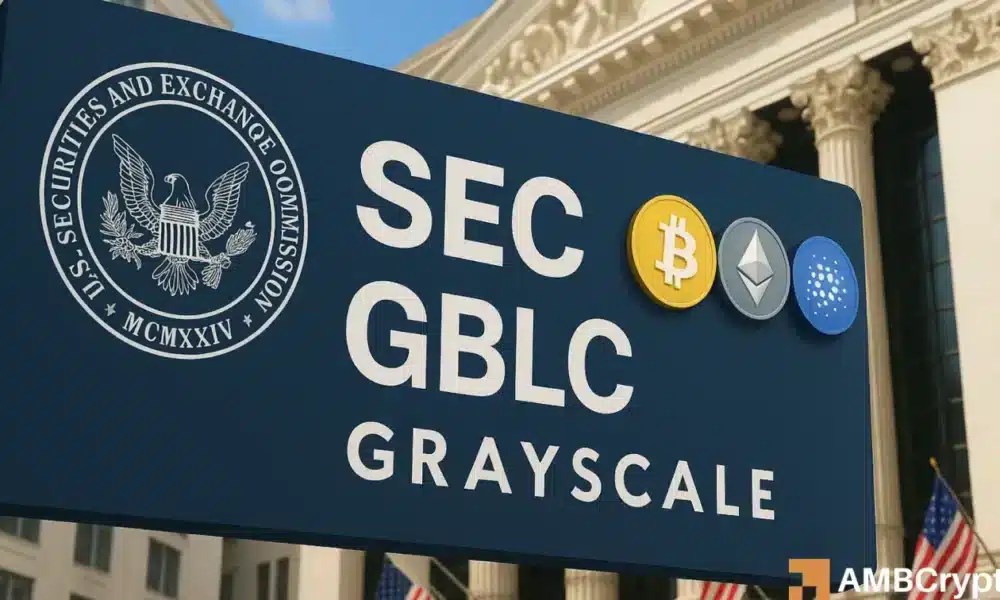
Grayscale’s ‘first multi-crypto asset ETP’ in the works: Will BTC, ETH win?

Grayscale’s ‘first multi-crypto asset ETP’ in the works: Will BTC, ETH win?

The post Grayscale’s ‘first multi-crypto asset ETP’ in the works: Will BTC, ETH win? appeared on BitcoinEthereumNews.com. Key Takeaways What does this approval mean for investors? It allows traditional investors to access diversified exposure to major cryptocurrencies without buying tokens directly. Which cryptocurrencies are included in GDLC? Bitcoin, Ether, XRP, Solana, and Cardano. The U.S. Securities and Exchange Commission (SEC) has greenlit the Grayscale Digital Large Cap Fund (GDLC) for stock exchange trading.  The approval, coinciding with relaxed ETF listing standards, opens the door for traditional investors to access the crypto market more easily and signals growing institutional support. Grayscale CEO Peter Mintzberg weighs in Grayscale CEO Peter Mintzberg confirmed the development on X (formerly Twitter), praising the SEC’s Crypto Task Force for providing much-needed clarity to the sector. He said,  “The Grayscale team is working expeditiously to bring the FIRST multi #crypto asset ETP to market with Bitcoin, Ethereum, XRP, Solana, and Cardano.” He further added,  “Thank you to the SEC #Crypto Task Force for their continued, unmatched efforts in bringing the regulatory clarity our industry deserves.” The newly approved Grayscale Digital Large Cap Fund (GDLC) offers investors exposure to five of the world’s largest cryptocurrencies: Bitcoin [BTC], Ethereum [ETH], Ripple [XRP], Solana [SOL], and Cardano [ADA]. Impact on included tokens Following the announcement, markets reacted positively. BTC traded at $117,153.61 after a 0.69% rise in the past 24 hours, Ether climbed 2.02% to $4,579.73, XRP at $3.10 up by 3.07%, Solana at $245.94 up by 4.78%, and Cardano reached $0.9130 up by 4.85%, per CoinMarketCap. By packaging multiple cryptocurrencies into a single ETP, GDLC allows traditional investors to gain diversified crypto exposure without the need to open exchange accounts or purchase individual tokens. This green light comes just months after the SEC had delayed Grayscale’s plan to convert GDLC from an over-the-counter fund to an ETP listed on NYSE Arca. With approval now granted, the fund is…
Paylaş
BitcoinEthereumNews2025/09/19 12:53

Trade GOLD, Share 1,000,000 USDT

Trade GOLD, Share 1,000,000 USDTTrade GOLD, Share 1,000,000 USDT

0 fees, up to 1,000x leverage, deep liquidity

