ETF

A crypto ETF is a regulated investment fund that tracks the price of one or more digital assets and trades on traditional stock exchanges like the NYSE or Nasdaq.Following the success of Bitcoin and Ethereum ETFs, the 2026 market now includes Solana ETFs and diversified Altcoin Baskets. ETFs serve as the primary vehicle for institutional capital and retirement funds (401k/IRA) to enter the Web3 space. This tag tracks regulatory approvals, AUM (Assets Under Management) inflows, and the impact of Wall Street on crypto liquidity.

40218 Articles
Created: 2026/02/02 18:52
Updated: 2026/02/02 18:52
Ethereum Sees Fresh Institutional Inflows — $5,000 Price Forecast Gaining Traction for 2025

Ethereum Sees Fresh Institutional Inflows — $5,000 Price Forecast Gaining Traction for 2025

Ethereum is once again at the center of institutional accumulation, with billions of dollars pouring into the asset as Wall […] The post Ethereum Sees Fresh Institutional Inflows — $5,000 Price Forecast Gaining Traction for 2025 appeared first on Coindoo.

Author: Coindoo
Xiao Feng's Bitcoin Asia 2025 speech: "ETFs are good! DATs are better!"

Xiao Feng's Bitcoin Asia 2025 speech: "ETFs are good! DATs are better!"

On August 28th, Dr. Xiao Feng, Chairman and CEO of HashKey Group, delivered a keynote speech titled "ETF is good! DAT is better!" at Bitcoin Asia 2025. This speech was compiled from on-site shorthand, with some deletions that do not affect the original meaning. In recent months, many friends have asked me a question. From on-chain Bitcoin trading to off-chain stock exchanges, Bitcoin has become a very popular investment tool in stock trading. So, is it more appropriate for such an investment tool to be in the form of an ETF or a DAT (Digital Asset Treasury)? My personal conclusion is that perhaps a model like DAT, just like when ETF first came out, is a revolution in new financial instruments. We know that stocks evolved from individual stocks traded on stock exchanges to index funds, and then to exchange-traded funds (ETFs). Innovations in financial instruments have created a vast new asset class. Cryptocurrency has evolved from on-chain to off-chain, allowing all stock market investors to easily and habitually access crypto assets through the stock market, a method that is now accessible to 99% of the population. So, which approach is better? ETFs or DATs? My personal opinion is that DATs may be the best way for crypto assets to move from on-chain to off-chain. We can see that currently, the only single commodity, single-asset investment tool in the global capital market is gold, the largest ETF. There aren't single-stock ETFs for stocks, because stocks are already traded on stock exchanges and are easily accessible. If you want to buy a basket of stocks, such as an index fund, you need other investment tools. Index funds or ETFs are the most convenient tools for traditional investors. Previously, single-asset ETFs were limited to gold, but with the launch of the BTC ETF, we now have a second type of single-asset ETF. This is a natural and natural progression, as ETFs are commonly used to create investment vehicles, making it easier for traditional stock market investors to invest in alternative assets, such as crypto. However, when valuing ETFs, we use Net Asset Value (NAV); while for DATs, we use Market Value (MMV). These two concepts are completely different. Market Value leads to greater price volatility, while NAV fluctuations are much smaller than Market Value. Therefore, as a single investment tool for crypto, I believe DATs are the preferred approach. Better liquidity The biggest advantage of DAT is that it has better liquidity than ETF, which is the most important and core point for any investor. My observation is that the smoothest and most effective way to convert cryptocurrencies into traditional financial assets is through exchanges. The growth of ETFs, on the other hand, comes from subscriptions and redemptions, which require three or more intermediaries and take one to two days to complete. This is clearly inferior to transactions on a distributed ledger, which can take as little as two or ten minutes. Therefore, transactions may be the primary method for converting between traditional financial and crypto assets in the future, making greater liquidity a core advantage of DATs over ETFs. Better price elasticity At the same time, market capitalization offers greater price elasticity than net asset value. We know that one of the key reasons MicroStrategy has been able to consistently build its financing structure through various financing instruments and hold a significant amount of Bitcoin is the inherent volatility of BTC. Furthermore, hedge funds and other alternative investors are drawn to investing because they can own a more volatile asset through shares, allowing them to split equity and bond over-the-counter, turning volatility into another tool for both price protection and arbitrage. Convertible bonds (CBs) are particularly popular, as they are often structured and broken down over-the-counter by hedge funds and alternative investment firms. Therefore, these institutions favor investing in companies like MicroStrategy, buying its shares or convertible bonds, because they can structure their investments. This offers greater price elasticity, something ETFs lack. More appropriate leverage ratio Third, it offers more appropriate leverage. Previously, single-asset investing was limited to two extremes: holding spot BTC or ETH, or buying futures or CME contracts. A significant gap exists in between. This gap allows listed companies to design appropriate leveraged financing structures. By simply holding shares, the company manages the leveraged structure, allowing you to enjoy a higher premium than the price growth of the cryptocurrency itself. Built-in fall protection Instruments like DATs offer a premium and inherent downside protection. Imagine if the stock price drops by more than the net asset value, this effectively provides investors with an opportunity to buy BTC or ETH at a discount. This market price fluctuation will quickly be eliminated by the market, providing a strong downside protection. Otherwise, you'd rather buy stocks, effectively buying BTC or ETH at a discount. Taking all these factors into consideration, DATs may be a more suitable financing tool for crypto assets. Just as ETFs were well-suited to index or basket investment strategies in the stock market, DATs may be a new trend we will see over the next three to five years. The scale of assets held by DATs may approach the scale covered by current stock market ETFs, perhaps within another ten years. Therefore, I believe DATs are a new investment tool with the greatest growth potential in the future. They are more suitable for crypto assets, while ETFs may be more suitable for stock assets. Of course, this is just my personal opinion. Thank you everyone.

Author: PANews
Cathie Wood’s Ark Invest Doubles Down on BitMine as Crypto Stock Tumbles

Cathie Wood’s Ark Invest Doubles Down on BitMine as Crypto Stock Tumbles

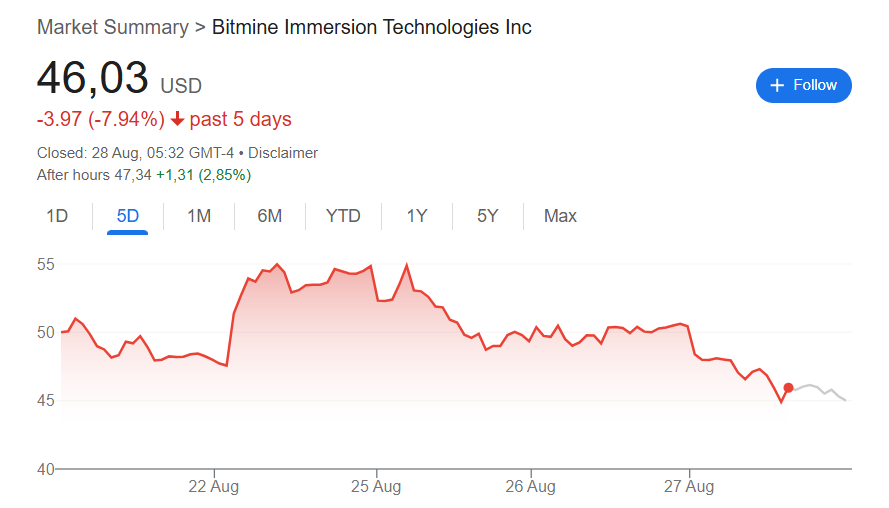
TLDR Ark Invest purchased $15.6 million worth of BitMine shares on Wednesday across three ETFs while the stock fell 7.85% BitMine stock dropped despite the company’s treasury holdings reaching $8.82 billion, including 1.71 million ETH worth $7.9 billion The purchases included 227,569 shares in ARKK, 70,991 shares in ARKW, and 40,553 shares in ARKF BitMine [...] The post Cathie Wood’s Ark Invest Doubles Down on BitMine as Crypto Stock Tumbles appeared first on CoinCentral.

Author: Coincentral
Institutions Weighing In Heavily on Ethereum as Market Flips Neutral

Institutions Weighing In Heavily on Ethereum as Market Flips Neutral

The broader crypto market has taken a cautious pause, with the Fear and Greed Index dropping to 45, but institutions are betting heavily on ETH. The post Institutions Weighing In Heavily on Ethereum as Market Flips Neutral appeared first on Coinspeaker.

Author: Coinspeaker
Active vs. Passive ETFs: Which is Right for Canadian Investors

Active vs. Passive ETFs: Which is Right for Canadian Investors

The post Active vs. Passive ETFs: Which is Right for Canadian Investors appeared on BitcoinEthereumNews.com. Exchange-traded funds (ETFs) have become one of the most popular investment methods in Canada. Many feel that in the past couple of years, these funds have replaced the practice of opening a TFSA for retirees managing RRIF withdrawals. The ETFs combine the diversification options and liquidity, which is what the investors are after. The main dilemma for Canadian investors is now whether to invest in active or passive ETFs. In this article, we’ll explain the difference between the two and provide guidance for investors on how to choose the one that suits them, based on their circumstances. The Canadian Context Before diving into the difference between passive and active ETFs, we should explain the Canadian investment context and how it differs from similar countries. Being pooled investment funds, ETFs trade on stock exchanges like individual stocks. When investors buy an ETF, they buy a bundle of securities, including stocks, bonds, commodities, and even other funds, without buying any of the assets directly. The Canadian financial sector is heavily concentrated in the domestic market, and this allows for diversification. Canada is a pioneer in the ETF markets. The world’s first ETF was created in Canada in 1990. At this point, Canada has about $400 billion in ETF assets. Their value also grows at a double-digit rate. The major players in the Canadian market include BlackRock’s iShares, Vanguard, BMO Global Asset Management, and new companies such as Purpose Investments and Horizons ETFs. Crypto ETFs Crypto ETFS are a recent introduction in the world of tradable assets. These funds allow the owners to trade with cryptos without buying any of the coins themselves. Instead, the value of the ETF remains tied to the market value of the cryptos it contains. For a while now, crypto experts such as Cryptomaniaks have been writing about…

Author: BitcoinEthereumNews
Xiao Feng: ETF is good, but DAT is better

Xiao Feng: ETF is good, but DAT is better

PANews reported on August 28 that Dr. Xiao Feng, Chairman and CEO of HashKey Group, said in his keynote speech at Bitcoin Asia 2025 today that DAT (Digital Asset Treasury) may be the best way to transfer crypto assets from on-chain to off-chain. Dr. Xiao Feng elaborated on the four core advantages of DAT over ETFs: First, it offers better liquidity. ETF subscriptions and redemptions take a long time, while DATs help investors transfer assets more conveniently and efficiently. Second, it offers greater price elasticity. DATs have large market capitalization fluctuations and possess risk isolation properties, providing institutions with more arbitrage tools. Third, the leverage ratio is more rationally designed. DAT companies provide a leveraged financing structure, which can bring higher premiums to investors compared to the price growth of cryptocurrencies themselves. Fourth, DATs have a built-in downside protection mechanism. When the stock price drops by more than the company's net asset value, investors have the opportunity to buy Bitcoin or ETFs at a discount. Such a situation where the stock price falls below the net asset value will be quickly smoothed out by the market.

Author: PANews
Cronos (CRO) soars over 100% in 48 hours; Here’s why

Cronos (CRO) soars over 100% in 48 hours; Here’s why

The post Cronos (CRO) soars over 100% in 48 hours; Here’s why appeared on BitcoinEthereumNews.com. Cronos (CRO) has staged one of its sharpest rallies on record, surging more than 53% in the past 24 hours and nearly 137% over the past week. The move was fueled by a wave of news connecting the token to both Donald Trump’s media empire and a proposed U.S. crypto ETF. Cronos 1-week price chart. Source: Finbold On July 8, Trump Media & Technology Group filed with the SEC for a “Crypto Blue Chip ETF,” which would allocate 5% of its portfolio to CRO alongside Bitcoin and Ethereum. While the SEC has delayed its ruling until October 8, optimism has remained strong, particularly as Crypto.com was tapped to custody the ETF’s assets. The momentum accelerated after Trump Media announced a partnership with Crypto.com to integrate CRO as the official utility token of the Truth Social platform on August 26. As part of the deal, Trump Media will purchase approximately 685 million CRO (worth around $105 million) for its balance sheet. 🚨 Breaking News: Today is a historic day for $CRO Trump Media Group CRO Strategy has announced $6.4B in funds to build America’s Cronos Treasury. At closing, Trump Media Group CRO Strategy is expected to be the world’s largest holder of CRO. Read the press release for more… pic.twitter.com/QQrSZLlKu4 — Crypto.com (@cryptocom) August 26, 2025 CRO market cap The dual catalysts drove CRO’s market capitalization from $5.45 billion to $11.51 billion in less than 48 hours, adding over $6 billion in value. From a technical standpoint, CRO broke above the critical $0.25 resistance with an RSI of 84.56, signaling overbought conditions but also confirming FOMO-driven momentum. With daily trading volumes topping $2.31 billion, analysts note that Fibonacci extensions suggest near-term upside targets in the $0.33–$0.45 range. CRO’s inclusion in a regulated ETF would open the door for institutional passive flows,…

Author: BitcoinEthereumNews
CME Ether Futures Open Interest Reaches Record $10 Billion

CME Ether Futures Open Interest Reaches Record $10 Billion

TLDR CME’s ether futures open interest hits record $10 billion as institutional investors increase participation Large open interest holders reach record 101, showing growing professional involvement in ether markets Ether price surged 23% this month, hitting lifetime highs above $4,900 Ether ETFs attracted $3.69 billion in August while Bitcoin ETFs saw $803 million outflow Bitcoin [...] The post CME Ether Futures Open Interest Reaches Record $10 Billion appeared first on CoinCentral.

Author: Coincentral
17 listed companies hold 3.4 million ETH, and institutional Ethereum holdings hit a record high in Q2

17 listed companies hold 3.4 million ETH, and institutional Ethereum holdings hit a record high in Q2

In the second quarter of 2025, institutional investors increased their holdings of ETH by 388,301 through ETFs, with investment advisory firms accounting for the highest adoption rate of Ethereum ETFs in the traditional financial sector. According to data shared by Bloomberg ETF analyst James Seyffart, investment advisory firms currently control $1.35 billion in Ethereum ETF holdings, corresponding to 539,757 ETH; in the past quarter, such institutions have increased their holdings by a net of 219,668 ETH. Investment advisory firms hold far more than other institutional categories: hedge fund managers rank second with $687 million in holdings, corresponding to 274,757 ETH, a 104% increase from the first quarter. Goldman Sachs leads the single institutional holder with $721.8 million in Ethereum ETF holdings, equivalent to 288,294 ETH. Jane Street Group followed closely with $190.4 million in holdings, while Millennium Management held $186.9 million in ETF shares. The concentrated participation of leading Wall Street institutions indicates that traditional investment portfolios have recognized Ethereum as a legitimate asset class. Brokerage firms are the third largest institutional category with holdings of $253 million, with a net increase of 13,525 ETH this quarter (an increase of 15.4%). Private equity firms and holding companies contributed $62.2 million and $60.6 million in holdings, respectively; while pension funds and banks reduced their Ethereum holdings. As of the end of the second quarter, the total holdings of Ethereum ETFs across all institutional categories tracked by Bloomberg Intelligence reached $2.44 billion, corresponding to a total of 975,650 ETH. Judging from the current data, institutional participation is expected to increase further significantly in the third quarter. Data from Farside Investors shows that Ethereum ETF inflows soared more than threefold from $4.2 billion on June 30 to $13.3 billion on August 26, setting a new record for cumulative inflows. In August alone, new inflows reached approximately $3.7 billion. This growth trend aligns with the continued rise in Ethereum adoption as a corporate treasury asset. According to data compiled by Strategic ETH Reserve, 17 publicly listed companies currently hold 3.4 million ETH, with a market capitalization of nearly $15.7 billion. On August 26, SharpLink announced its latest holdings, adding 56,533 ETH to its treasury, bringing its total holdings to 797,704 ETH. However, this is still far less than BitMine's 1,713,899 ETH (market value of nearly $8 billion).

Author: PANews
Ripple CTO Refutes XRP Centralization Claims, Stresses GovernanceRipple CTO Refutes XRP Centralization Claims, Highlights Blockchain Governance

Ripple CTO Refutes XRP Centralization Claims, Stresses GovernanceRipple CTO Refutes XRP Centralization Claims, Highlights Blockchain Governance

The post Ripple CTO Refutes XRP Centralization Claims, Stresses GovernanceRipple CTO Refutes XRP Centralization Claims, Highlights Blockchain Governance appeared on BitcoinEthereumNews.com. CTO explains that fork mechanics apply equally to Bitcoin, Ethereum, and XRPL systems. Forks enable rule changes, but markets often consolidate value into one dominant chain. Decentralization can still allow harmful changes if backed by a majority consensus. Ripple CTO David Schwartz has addressed centralization accusations following social media discussions about XRP’s market capitalization relative to BlackRock. The debate began when users claimed XRP operates as a “centralized VC project using supermajority nodes.” This prompted Schwartz to clarify the mechanics of blockchain governance. Schwartz argued that all public layer one blockchains face similar governance challenges and stated that “any group of participants could change the rules to allow censorship” if they achieve consensus. This capability exists across Bitcoin, Ethereum, and XRP Ledger systems, not exclusively within Ripple’s network architecture. This is true of every public layer one blockchain. Any group of participants could change the rules to allow censorship by considering invalid all transactions that violate their censorship rules and it would affect all of those who agreed to the change. — David ‘JoelKatz’ Schwartz (@JoelKatz) August 27, 2025 Fork Mechanisms Enable Rule Changes Across All Blockchains When questioned about forking impacts on blockchain foundations, Schwartz explained that serious governance disagreements in any public blockchain can result in network splits. Each side can pursue preferred rules through forking mechanisms, though neither can force adoption by opposing participants. The CTO acknowledged the theoretical benefits of successful forks, including doubled transaction capacity and specialized use case optimization. Holders could potentially benefit if their tokens replicate across both chains while maintaining a combined value above the original network. However, Schwartz noted that practical fork implementations have generally failed to deliver promised benefits. Market situations typically favor one chain over alternatives and concentrate economic value rather than distributing it across multiple networks, as theory…

Author: BitcoinEthereumNews