ETF

A crypto ETF is a regulated investment fund that tracks the price of one or more digital assets and trades on traditional stock exchanges like the NYSE or Nasdaq.Following the success of Bitcoin and Ethereum ETFs, the 2026 market now includes Solana ETFs and diversified Altcoin Baskets. ETFs serve as the primary vehicle for institutional capital and retirement funds (401k/IRA) to enter the Web3 space. This tag tracks regulatory approvals, AUM (Assets Under Management) inflows, and the impact of Wall Street on crypto liquidity.

40005 Articles
Created: 2026/02/02 18:52
Updated: 2026/02/02 18:52
BlockchainFX, Snorter Token, or Bitcoin Hyper?

BlockchainFX, Snorter Token, or Bitcoin Hyper?

The post BlockchainFX, Snorter Token, or Bitcoin Hyper? appeared on BitcoinEthereumNews.com. Crypto News Cryptocurrency investors know that getting in early on a presale can be the ticket to massive returns. Unfortunately, many miss out on those life-changing opportunities because they wait too long to take action. Think about the early days of Bitcoin when a mere handful of investors bought in, and now look at the price! While many are regretting that missed opportunity, BlockchainFX offers an incredible second chance to get in early with minimal risk, explosive growth potential, and long-term benefits. Let’s dive into the top crypto presales you should watch, and why BlockchainFX stands head and shoulders above the rest. The Top Crypto Presales You Can’t Miss Snorter Token: A Meme Coin with Big Promises Snorter Token is part of the ever-growing meme coin trend, which has seen coins like Dogecoin and Shiba Inu explode in value. While meme coins are known for their community-driven nature and often explosive short-term growth, they carry significant risks. Snorter Token aims to capitalize on the meme coin hype but lacks the solid infrastructure and market versatility offered by other presale projects. Although the Snorter Token presale might see some initial buzz, there’s no denying that meme coins can be volatile, and their long-term value often depends on unpredictable community-driven forces. The problem with meme coins is that they come with little utility outside of speculative trading, and their price is driven by hype rather than solid fundamentals. But what if you could invest in a presale that not only rewards you with daily profits but also gives you long-term growth potential? That’s where BlockchainFX takes the lead. Bitcoin Hyper: The DeFi Innovator With Big Claims Bitcoin Hyper brings the DeFi revolution to the forefront, attempting to offer a platform that enhances decentralized trading. With its primary focus on decentralized finance (DeFi),…

Author: BitcoinEthereumNews
Canary Files S-1 for American-Made Crypto ETF

Canary Files S-1 for American-Made Crypto ETF

PANews reported on August 25th that Bloomberg ETF analyst Eric Balchunas wrote on the X platform: "The newly submitted 'Canary American-Made Crypto ETF' application (S-1 filing) - this spot product will only hold cryptocurrencies that were invented entirely in the United States, mined primarily in the United States, or have operations centers located in the United States. As we previously predicted, due to the success of this category, ETFs are ready to try all imaginable combinations."

Author: PANews
Ethereum (ETH) Price: Large Holders Accumulate 350,000 ETH as Asset Trades Near All-Time High

Ethereum (ETH) Price: Large Holders Accumulate 350,000 ETH as Asset Trades Near All-Time High

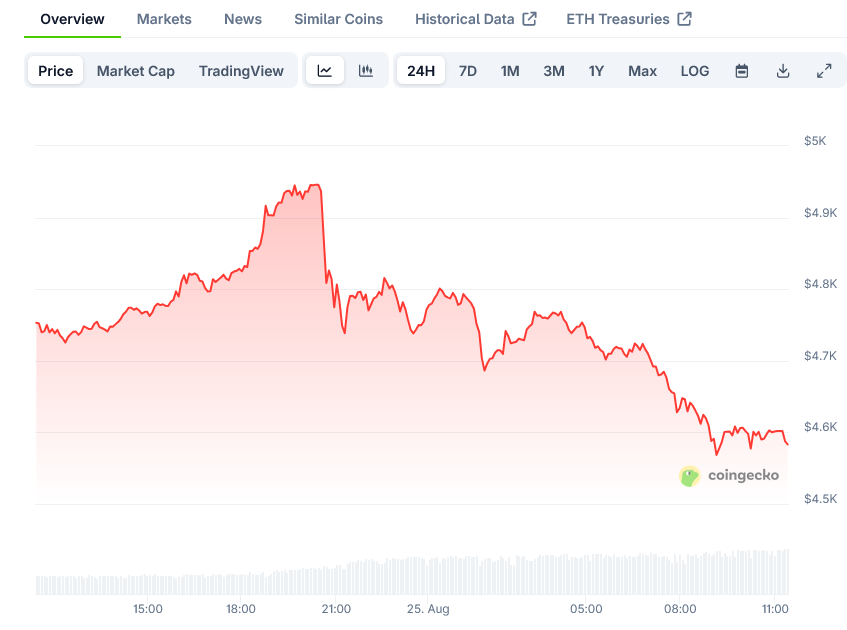
TLDR Ethereum Futures volume reached $162.6 billion, claiming 50% of the total futures market ETH is trading at $4,763, slightly below its recent all-time high Large holders accumulated 350,000 ETH (worth $1.67 billion) over the past week Open Interest increased from $59 billion to $70 billion, with funding rates at a 7-month high Ethereum must [...] The post Ethereum (ETH) Price: Large Holders Accumulate 350,000 ETH as Asset Trades Near All-Time High appeared first on Blockonomi.

Author: Blockonomi
Grayscale Files S-1 for AVALANCHE ETF

Grayscale Files S-1 for AVALANCHE ETF

PANews reported on August 25 that according to the filing documents on the US SEC official website, Grayscale submitted the S-1 document for the AVALANCHE ETF.

Author: PANews
Can Ethereum Flip Bitcoin Soon? Here’s What Experts Say

Can Ethereum Flip Bitcoin Soon? Here’s What Experts Say

The post Can Ethereum Flip Bitcoin Soon? Here’s What Experts Say appeared first on Coinpedia Fintech News Ethereum is the crypto world’s favorite right now. And the predictions are getting more and more interesting by the day.  Real Vision CEO Raoul Pal shared his outlook on X, saying: “My general thesis for the full cycle is ETH outperforms BTC. SOL outperforms ETH and SUI outperforms SOL due to where they all are …

Author: CoinPedia
Analysis: Whales expect ETH to outperform BTC, and this trend will be strengthened if an ETH staking ETF is approved

Analysis: Whales expect ETH to outperform BTC, and this trend will be strengthened if an ETH staking ETF is approved

PANews reported on August 25th that Singapore-based crypto investment firm QCP Capital announced that an early Bitcoin holder sold approximately 24,000 Bitcoins (approximately $2.7 billion) during low market liquidity on Sunday. Bitcoin's post-Jackson Hole rally quickly faded and led to a flash crash, wiping out approximately $500 million in leveraged positions within minutes. Previously, Bitcoin had been trading in a narrow range, while Ethereum had been reaching new highs. This trend persisted for about a week. Bitcoin transfers from old wallets to Ethereum pushed the exchange rate above 0.04, with Ethereum leading the gains. The market volatility reflects weakening institutional demand in related markets. Spot Bitcoin ETFs have seen net outflows of approximately $1.2 billion for six consecutive days, and Strategy's August purchases were also lower than usual. Meanwhile, institutions such as BitMine increased their holdings of Ethereum, supporting its price and upward momentum. As funds shifted from Bitcoin to Ethereum, Bitcoin's dominance fell from 60% to 57%. While still higher than the sub-50% level seen during the 2021 altcoin season, the holdings have fueled speculation that whales (large holders) anticipate Ethereum's outperformance. This view would be further bolstered if an Ethereum-collateralized ETF is approved later this year. While Bitcoin appears to be ceding momentum to Ethereum in the near term, its structural view on Bitcoin remains unchanged. As was the case in July when the market absorbed the remaining supply of approximately 80,000 Bitcoins, institutions are expected to selectively buy on dips.

Author: PANews
SEI Price Prediction: Will It Break $1.14 or Fall Below $0.23?

SEI Price Prediction: Will It Break $1.14 or Fall Below $0.23?

SEI is currently trading at $0.3154, having fallen 2.11% over the last 24 hours. Despite the prices falling, the volume increased to a level of $223.25 million from an 18.1% growth, indicative of heightened interest among the investors. It had an 8.25% drop over the past week, the average SEI being valued at $0.3163. Current […]

Author: Tronweekly
XRP Shakes Up Global Finance: Court Win, ETF Frenzy, Malaysia’s Nod, and a 75% Rally Ahead

XRP Shakes Up Global Finance: Court Win, ETF Frenzy, Malaysia’s Nod, and a 75% Rally Ahead

Ripple’s long battle with U.S. regulators reached a turning point after the Court of Appeals for the Second Circuit finalized the dismissal of Ripple’s appeal on August 22. The decision closed the door on further appellate proceedings in the Securities and Exchange Commission lawsuit. The ruling confirmed that XRP traded on public exchanges is not […] The post XRP Shakes Up Global Finance: Court Win, ETF Frenzy, Malaysia’s Nod, and a 75% Rally Ahead appeared first on CoinChapter.

Author: Coinstats
Crypto VCs in a bull market: Raising funds is as difficult as climbing to the sky

Crypto VCs in a bull market: Raising funds is as difficult as climbing to the sky

By Yogita Khatri Compiled by Tim, PANews In my last installment, I discussed how the "Summer of Digital Asset Treasurys (DATs)" siphoned attention and funding away from traditional startup funding rounds. At the time, some venture capital firms also raised another issue: limited partners (LPs) were becoming wary of investing in crypto funds. In this installment, I'll delve deeper into why raising crypto venture capital funds has become more difficult, even during a bull market, and what this means for the future. Several venture capitalists told me that after the collapse of Terra (LUNA) and FTX in 2022, fundraising became significantly more difficult, which not only eroded LP trust but also damaged the reputation of the entire industry. Lattice Fund co-founder Regan Bozman said: "While the perception of the crypto market has improved significantly, this has not offset the widespread concerns about venture capital performance. The new challenge facing crypto venture capital today is the need to compete with ETFs and DATs for funds." Neoclassic Capital co-founder Michael Bucella stated that only funds with clear advantages or impressive track records are now able to attract consistent LP capital inflows. This market shift has driven what Dragonfly General Partner Rob Hadick calls a "flight to quality." He noted that in 2024, just 20 firms attracted 60% of all LP capital, while another 488 firms captured the remaining 40%. While liquidity has improved this year through mergers and acquisitions and IPOs, financing barriers remain significantly higher than before the 2022 market crash. Broader data supports this. Data from The Block Pro, provided by my colleague Ivan Wu, shows a sharp decline in crypto venture fund raising since the boom of 2021-2022. In 2022, over $86 billion was raised across 329 funds. This figure plummeted to $11.2 billion in 2023 and further to $7.95 billion in 2024. By 2025, only 28 funds had raised $3.7 billion, highlighting the challenging nature of the current fundraising environment. Both funding sizes and the number of funds are declining sharply, reflecting LP caution and a growing selection of capital. Several venture capital firms told me that family offices, wealthy individuals, and crypto-native funds are still actively supporting crypto venture capital. However, since 2022, pension funds, endowment funds, parent funds, and corporate venture capital departments have mostly chosen to withdraw, resulting in a smaller and more selective LP group. Why raising capital is harder now than in 2021 or early 2022 The unique circumstances of the previous bull market cycle meant that nearly anyone could raise a crypto venture capital fund in 2021, even those with little experience. However, many of these funds have yet to return capital to investors. Limited partners (LPs) are now demanding tangible paid-in capital distributions before committing to new funds. Sep Alavi, General Partner at White Star Capital, stated, "LPs are increasingly skeptical of unrealized gains and are prioritizing funds with a track record of realized returns." The interest rate hike cycle since March 2022 has also prompted capital allocators to shift to safer, more liquid assets. Steve Lee, co-founder of Neoclassic Capital, noted that gains in this cycle have primarily been concentrated in Bitcoin, Ethereum, and a few blue-chip stocks through ETFs and DATs, with little benefit reaching smaller projects that typically represent venture capital value. Lee stated, "LPs see short-term gains in large-cap stocks, while venture capital takes longer to realize value." An unnamed early-stage venture capital founder added that the lack of "altcoin buying" since the 2021-22 cycle has dampened LPs' appetite for tokens, as few tokens have outperformed. Many crypto VCs are investing in tokens. Artificial intelligence is also a major factor: Lattice Fund's Bozman said, "AI is the catch-all buzzword that's attracting a lot of interest from LPs focused on the tech sector." Overall, while financing may not be as difficult today as it was in the years after the Luna and FTX crashes, it is still much more severe than the loose period of hot money influx from 2021 to early 2022. What the future of crypto venture capital looks like If fundraising continues to be difficult, most venture capital firms anticipate a wave of industry consolidation, with smaller, weaker, or less distinctive funds quietly exiting the market. Alavi predicts that small or underperforming funds will struggle to raise follow-up funds, while Hadick points out that the market is already shrinking as capital concentrates on the top players. The early crypto venture capital founder believes that mid-sized funds will become hollowed out: small funds under $50 million with cutting-edge advantages will survive, and giant funds like Paradigm and a16z will continue to grow, but underperforming mid-sized funds will gradually disappear. He added that the crypto venture market may increasingly resemble a traditional market structure, with smaller but higher-quality venture capital firms supporting a large liquidity base. Bucella said: "Capital markets have a wonderful ability to self-correct. We are moving beyond a period of over-allocation to venture capital and under-allocation to liquid strategies." Others believe the model itself is evolving. Erick Zhang of Nomad Capital predicts that the number of purely cryptocurrency-focused firms will decrease, Web2 venture capital firms will expand into crypto, and crypto funds will expand into Web2 businesses. The timeline for a large-scale return of liquidity providers is uncertain. Neoclassic’s Lee said investors will return once capital shifts from Bitcoin and Ethereum to the mid- and low-cap token ecosystems, a shift he expects to be accelerated by on-chain capital flows driven by stablecoins. Alavi believes that institutional investors may return by mid-2026 as falling interest rates and mergers and acquisitions boost capital allocation. Hadick believes that, with the exception of pension funds, most institutional investors have already returned and predicts that pension funds will return to the market over the next few years as regulations become clearer and the market matures. The early-stage venture capital founder stated that LPs will not return en masse unless the next "super-hot narrative" emerges, such as stablecoins or breakthrough use cases.

Author: PANews
Bitcoin Digital Gold: Larry Fink’s Crucial Endorsement Amidst Currency Concerns

Bitcoin Digital Gold: Larry Fink’s Crucial Endorsement Amidst Currency Concerns

BitcoinWorld Bitcoin Digital Gold: Larry Fink’s Crucial Endorsement Amidst Currency Concerns The financial world is buzzing with a significant shift in perspective from one of its most influential figures. Larry Fink, the CEO of BlackRock, the world’s largest asset manager, has publicly endorsed Bitcoin digital gold. This crucial declaration signals a growing mainstream acceptance of cryptocurrency, especially as a hedge against economic instability. Larry Fink’s Transformative View on Bitcoin Digital Gold Larry Fink’s journey with Bitcoin has been quite remarkable. Initially, he viewed Bitcoin (BTC) with skepticism, even considering it a tool for illicit activities like money laundering. However, the unprecedented economic shifts brought on by the COVID-19 pandemic prompted a profound re-evaluation of his stance. This change of heart highlights a growing understanding of blockchain technology’s underlying strength and its potential. Past Skepticism: Fink once saw Bitcoin primarily as a means for illicit transactions. Pandemic Catalyst: The global economic response to COVID-19 spurred a re-assessment. New Perspective: He now recognizes the robust nature of blockchain technology. During an interview on Citi’s YouTube channel, as reported by Bitcoin Magazine on X, Fink openly shared his evolved view. He now firmly considers BTC to be a form of Bitcoin digital gold, capable of safeguarding assets against the erosion of fiat currencies. This endorsement from such a prominent financial leader is a game-changer for the cryptocurrency market. Why the Shift? Understanding Currency Debasement What exactly led to Fink’s dramatic change of opinion? The concept of currency debasement is central to his new perspective. Fiat currencies, issued by governments, can lose value over time due to various factors, including inflation, quantitative easing, and economic policies. When governments print more money or increase national debt, the purchasing power of existing currency often diminishes. This debasement directly impacts savings and investments, leading individuals and institutions to seek alternative stores of value. Historically, gold has served this purpose, acting as a reliable hedge against inflation and economic uncertainty. However, in the digital age, Bitcoin digital gold is emerging as a compelling alternative. Fink’s comments underscore a broader concern among investors about the long-term stability of traditional financial systems. Therefore, the search for assets that maintain their value independently of government policy is intensifying. Bitcoin Digital Gold: A New Economic Paradigm? The idea of Bitcoin as ‘digital gold’ is not new, but Fink’s adoption of this term gives it significant weight. Like traditional gold, Bitcoin has a finite supply (capped at 21 million coins), making it inherently scarce. This scarcity is a key factor in its potential to act as a store of value, much like precious metals. Moreover, Bitcoin’s decentralized nature means it operates independently of central banks and governments. This autonomy offers a unique advantage for those looking to protect their wealth from political interference or economic mismanagement. The underlying blockchain technology provides transparency and security, making transactions immutable and verifiable. Benefits of Bitcoin digital gold as a hedge: Scarcity: Limited supply of 21 million coins. Decentralization: Operates outside government control. Security: Powered by robust blockchain technology. Portability: Easily transferable across borders digitally. Navigating the Future: Challenges and Opportunities for Bitcoin Digital Gold While the endorsement from a figure like Larry Fink is undeniably positive, the journey for Bitcoin digital gold is not without its challenges. Regulatory clarity remains a significant hurdle in many jurisdictions, impacting its widespread adoption. Market volatility also presents risks, as Bitcoin’s price can experience rapid fluctuations. However, the opportunities are immense. Institutional interest, as evidenced by BlackRock’s own initiatives (such as their spot Bitcoin ETF application), continues to grow. This increasing institutional involvement could bring more stability and liquidity to the market, further solidifying Bitcoin’s role as a legitimate asset class. As the world becomes more digitized, the appeal of a decentralized, secure, and scarce digital asset will likely only increase. In conclusion, Larry Fink’s shift in perspective from skeptic to advocate for Bitcoin digital gold marks a pivotal moment. His recognition of Bitcoin’s potential as a safeguard against currency debasement highlights a growing understanding of cryptocurrency’s fundamental value proposition. This endorsement not only legitimizes Bitcoin further but also signals a broader acceptance of digital assets in the global financial landscape. As traditional economic models face new pressures, Bitcoin offers a compelling, modern solution for wealth preservation. Frequently Asked Questions (FAQs) What did Larry Fink initially think of Bitcoin? Larry Fink initially viewed Bitcoin with skepticism, considering it primarily a tool for money laundering and other illicit activities. Why did Larry Fink change his view on Bitcoin? His view changed during the COVID-19 pandemic, as he came to recognize the strength of blockchain technology and Bitcoin’s potential to protect assets from fiat currency debasement. What does Larry Fink mean by ‘Bitcoin digital gold’? By ‘Bitcoin digital gold,’ Fink refers to Bitcoin’s role as a store of value and a hedge against inflation and the devaluation of traditional fiat currencies, similar to how physical gold has historically functioned. How does Bitcoin protect against currency debasement? Bitcoin protects against currency debasement due to its finite supply (21 million coins), decentralized nature, and independence from government monetary policies, making it a scarce asset that cannot be easily inflated. Is BlackRock involved with Bitcoin? Yes, BlackRock has shown increasing interest in Bitcoin, notably through their application for a spot Bitcoin Exchange-Traded Fund (ETF), indicating institutional adoption. What are the main challenges for Bitcoin’s adoption as digital gold? Key challenges include regulatory uncertainty, market volatility, and the need for broader public understanding and education about its underlying technology and value proposition. Did you find this article insightful? Share it with your friends, colleagues, and anyone interested in the evolving world of cryptocurrency and financial innovation! Your support helps us bring more crucial insights to light. To learn more about the latest Bitcoin digital gold trends, explore our article on key developments shaping Bitcoin’s institutional adoption. This post Bitcoin Digital Gold: Larry Fink’s Crucial Endorsement Amidst Currency Concerns first appeared on BitcoinWorld and is written by Editorial Team

Author: Coinstats