Liquidation

Liquidation occurs when a trader’s collateral is no longer sufficient to cover their leveraged position’s losses, triggering an automated forced closure by the exchange's liquidation engine. It is a critical risk-management mechanism that ensures the solvency of lending protocols and derivative platforms. In 2026, the focus has moved toward MEV-resistant liquidation models that protect users from predatory "cascades." This tag provides essential information on maintenance margins, health factors, and how to avoid liquidation in high-volatility environments.

15266 Articles
Created: 2026/02/02 18:52
Updated: 2026/02/02 18:52
Worst Crypto Crash in History as $19B Were Liquidated, But MemeCore and MAGACOIN FINANCE Show Incredible Strength

Worst Crypto Crash in History as $19B Were Liquidated, But MemeCore and MAGACOIN FINANCE Show Incredible Strength

The cryptocurrency market is stabilizing after one of the most violent crashes in modern history, triggered by President Donald Trump’s surprise announcement of a 100% tariff on all Chinese imports. The policy, set to take effect on November 1, rattled investors globally and unleashed the most severe wave of crypto liquidations seen in years. The fallout was immediate. Within hours, the crypto market shed more than $200 billion in value, with leveraged positions collapsing across major exchanges. Bitcoin (BTC) plunged below $106,000 before recovering to $112,000, while Ethereum (ETH) rebounded from $3,500 to $3,800 after intense panic selling. Meanwhile, XRP and Solana (SOL) fell 13.5% and 16.1%, respectively, as liquidity evaporated. According to data, over $19.3 billion worth of leveraged positions were liquidated within 24 hours, impacting more than 1.6 million traders. Analysts described the event as “panic-driven,” spurred by fears of a prolonged U.S. – China trade war that could reshape capital flows for the rest of 2025. Despite the carnage, key altcoins have begun to show remarkable resilience, particularly in sectors that blend utility with cultural momentum. Among them, MemeCore and MAGACOIN FINANCE stand out as bright spots in an otherwise battered market. MAGACOIN FINANCE Emerges as a Post-Crash Power Player Amid the chaos, MAGACOIN FINANCE has drawn growing attention for its strength, structure, and staying power. While many tokens struggled to maintain visibility during the crash, MAGACOIN FINANCE continued building momentum through its $16 million+ presale milestone, HashEx and CertiK audits, and scarcity-driven tokenomics. Its community presence on X and Telegram remains one of the most active in the altcoin space, providing consistent visibility even as markets turned red. Analysts projecting 50× upside potential say that MAGACOIN FINANCE is emerging as a strategic accumulation target for investors seeking growth exposure without overleveraging. What makes MAGACOIN FINANCE notable in this cycle is its contrast to speculative meme assets, it blends cultural relevance with audit-backed credibility, bridging a gap that has long divided crypto retail enthusiasm from institutional confidence. As capital rotates from short-term trades to projects with stronger foundations, MAGACOIN FINANCE’s clear roadmap and token structure position it as a natural beneficiary of post-crash capital reallocation. Market watchers note that volatility tends to accelerate the discovery of quality projects. In that context, MAGACOIN FINANCE’s continued growth during one of the worst crashes in crypto history signals that it’s not merely surviving turbulence, it’s thriving within it. MemeCore Defies Market Panic with Proof-of-Meme Innovation While nearly every token posted double-digit losses, MemeCore (MEME) shocked analysts by gaining 7.87% in 24 hours and 6.07% on the week, defying the selloff. Trading volume more than doubled to $39.8 million, even as broader liquidity dried up. The project’s strength comes from its Proof-of-Meme (PoM) consensus mechanism, a creative spin on blockchain validation that rewards community engagement and meme-driven activity rather than traditional staking or mining. This innovation, paired with EVM compatibility, attracted retail traders seeking stability within a familiar Layer 1 ecosystem. MemeCore’s total market cap has now reached $2.32 billion, cementing it as one of the top-performing Layer 1s of 2025. The upcoming MemeX Festival on October 15 is also generating excitement, as it promises to showcase a wave of new meme-based applications and NFT integrations built on the platform. Analysts at CoinMarketCap’s momentum desk note that MemeCore’s performance highlights an emerging pattern: in moments of macro fear, traders are shifting from high-beta DeFi and AI tokens toward community-led, culturally resilient ecosystems. However, experts caution that the project’s relatively low liquidity compared to its market cap could amplify volatility during sharp market moves. Even with that caveat, MemeCore’s ability to rally during the sharpest market drop of 2025 underscores its growing role as a niche safe haven for retail sentiment. The Road Ahead: From Capitulation to Confidence This week’s $20 billion liquidation was a harsh reminder of crypto’s vulnerability to macro shocks. Yet, as seen in prior cycles, these events often serve as catalysts for renewal. Institutional buying near Bitcoin’s lows suggests that large players are treating this panic as an accumulation opportunity. Meanwhile, resilient altcoins like MemeCore and MAGACOIN FINANCE are capturing the imagination of retail investors seeking both innovation and stability. With the market rebounding from the brink, the coming weeks will test whether these altcoins can sustain their momentum amid geopolitical uncertainty. If they can, both MemeCore’s cultural narrative and MAGACOIN FINANCE’s scarcity-backed framework may define the recovery phase leading into 2026. To learn more about MAGACOIN FINANCE, visit:Website: https://magacoinfinance.comAccess: https://magacoinfinance.com/accessTwitter/X: https://x.com/magacoinfinanceTelegram: https://t.me/magacoinfinance

Author: Coinstats
Tether, Circle minted $1.75 billion in new stablecoins to inject liquidity and stabilize markets

Tether, Circle minted $1.75 billion in new stablecoins to inject liquidity and stabilize markets

Decentralized finance players and major crypto institutions are moving swiftly to restore stability and confidence after one of the sharpest sell-offs in the digital asset market this year, with stablecoin issuers Tether and Circle minting billions in new tokens and Ethereum’s largest treasury firm, Bitmine, scooping up large amounts of Ethereum. The October 10 crash, […]

Author: Cryptopolitan
Relax, Bitcoin is going to be ok, even if BTC lost 13% in 8 hours: The proof is in the data

Relax, Bitcoin is going to be ok, even if BTC lost 13% in 8 hours: The proof is in the data

                                                                               Bitcoin’s $16,700 drop on Friday triggered $5B in futures liquidations, exposing a fragile market structure and renewed volatility despite this year’s spot BTC ETF-driven optimism.                     Key takeaways:Friday’s Bitcoin price crash shows volatility persists in the spot BTC ETF era, with leverage and liquidity stress amplifying losses.Liquidations hit $5 billion as portfolio margin systems failed, highlighting risks of illiquid collateral assets.Read more

Author: Coinstats
64% Flash Crash as DeFi Protocol Endures ‘Largest Stress Test’

64% Flash Crash as DeFi Protocol Endures ‘Largest Stress Test’

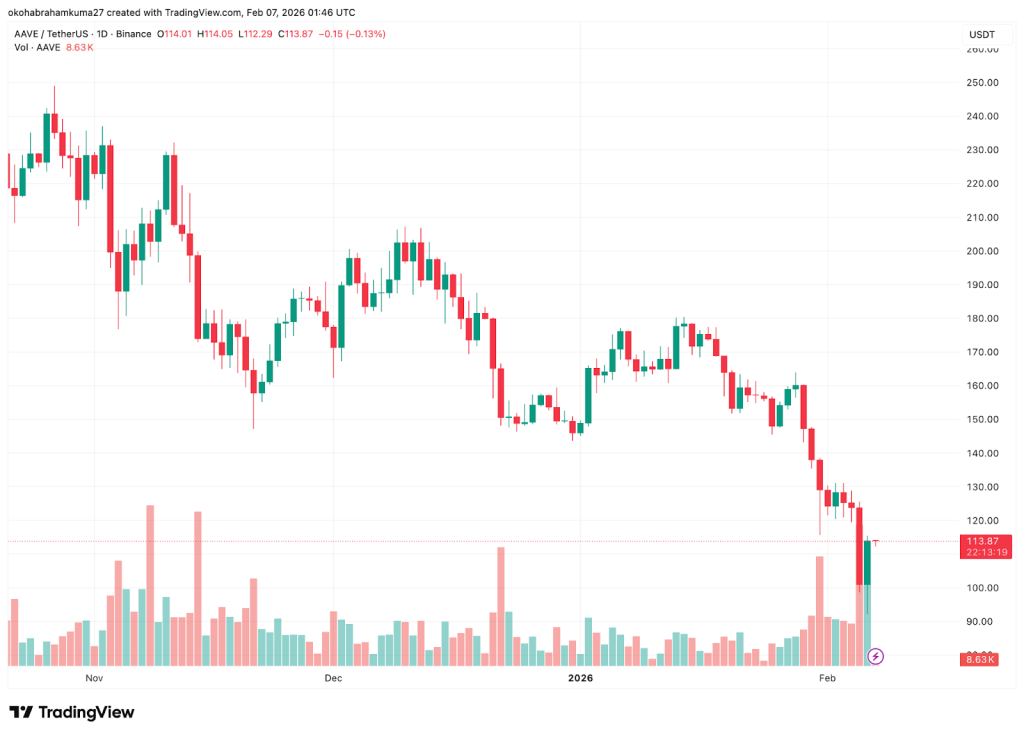
The post 64% Flash Crash as DeFi Protocol Endures ‘Largest Stress Test’ appeared on BitcoinEthereumNews.com. The native token of Aave AAVE$231.64, the largest decentralized crypto lending protocol, was caught in the middle of Friday’s crypto flash crash while the protocol proved resilient in a historic liquidation cascade. The token, trading at around $270 earlier in Friday, nosedived as much as 64% later in the session to touch $100, the lowest level in 14 months. It then staged a rapid rebound to near $240, still down 10% over the past 24 hours. Stani Kulechov, founder of Aave, described Friday’s event as the “largest stress test” ever for the protocol and its $75 billion lending infrastructure. The platform enables investors to lend and borrow digital assets without conventional intermediaries, using innovative mechanisms such as flash loans. Despite the extreme volatility, Aave’s performance underscores the evolving maturity and resilience of DeFi markets. “The protocol operated flawlessly, automatically liquidating a record $180M worth of collateral in just one hour, without any human intervention,” Kulechov said in a Friday X post. “Once again, Aave has proven its resilience.” Key price action: AAVE sustained a dramatic flash crash on Friday, declining 64% from $278.27 to $100.18 before recuperating to $240.09. The DeFi protocol demonstrated remarkable resilience with its native token’s 140% recovery from the intraday lows, underpinned by substantial trading volume of 570,838 units. Following the volatility, AAVE entered consolidation territory within a narrow $237.71-$242.80 range as markets digested the dramatic price action. Technical Indicators Summary Price range of $179.12 representing 64% volatility during the 24-hour period. Volume surged to 570,838 units, substantially exceeding the 175,000 average. Near-term resistance identified at $242.80 capping rebound during consolidation phase. Disclaimer: Parts of this article were generated with the assistance from AI tools and reviewed by our editorial team to ensure accuracy and adherence to our standards. For more information, see CoinDesk’s full AI…

Author: BitcoinEthereumNews
Dogecoin Plunges 8% but Whales Step In to Save Price While Another Penny Crypto Eyes 25x Rally

Dogecoin Plunges 8% but Whales Step In to Save Price While Another Penny Crypto Eyes 25x Rally

The post Dogecoin Plunges 8% but Whales Step In to Save Price While Another Penny Crypto Eyes 25x Rally appeared on BitcoinEthereumNews.com. As Dogecoin (DOGE) fell by 8% in recent trading, markets were at a loss to determine if this decline was a short-term correction or the start of a deeper retreat. Whales came in at the $0.25 support point, easing the fall, while retail investors debated whether to buy the dip or wait for clearer trends. Amid this volatility, another crypto went under the radar and silently attracted the attention of savvy investors.  Mutuum Finance (MUTM), now valued at a mere $0.035, has already raised over $17.1 million from over 16,840 investors in its presale. Mutuum Finance combines real-world usability and the type of growth potential that can provide 25x returns.  Dogecoin Dips 8% as Whales Step In, Support Holds Near $0.25 Dogecoin (DOGE) fell 8% on Tuesday as whales sold into $0.27 resistance, which caused a billion-token liquidation wave but saw late-session buying near $0.25 suggest a potential technical floor. Traders are closely watching to see if support will prevail over macroeconomic uncertainty, for example, near 98% probability of global monetary easing by year-end that has been behind volatilities in FX and crypto markets. Institutional focus remains in the frame, with ETF submissions by Grayscale and Bitwise maintaining DOGE on broad liquidity conversation, and ongoing mining investment through 2025 is testimony to accumulation and whales’ long-term conviction.  Intraday trading experienced sharp declines in the 13:00–15:00 UTC range but a late-day recovery and double-bottom action supported $0.25 as a significant support, averting an absolute drop into the $0.24 range. Although DOGE’s survivability serves to prove the durability of established meme-coins, new DeFi project with structured utility, Mutuum Finance (MUTM), is quietly attracting investor attention for its capacity to usher in colossal growth within evolving crypto marketplaces.  Mutuum Finance Presale Picking Up Momentum Mutuum Finance (MUTM) is in Presale Stage 6, having…

Author: BitcoinEthereumNews
How Auto-Deleveraging on Crypto Perp Trading Platforms Can Shock and Anger Even Advanced Traders

How Auto-Deleveraging on Crypto Perp Trading Platforms Can Shock and Anger Even Advanced Traders

Auto-deleveraging is the emergency brake in crypto perpetuals that cuts part of winning positions when bankrupt liquidations overwhelm market depth and a venue’s remaining buffers, as Ambient Finance Founder Doug Colkitt explains in a new X thread.Perpetual futures — “perps” in trading shorthand — are cash-settled contracts with no expiry that mirror spot via funding payments, not delivery. Profits and losses net against a shared margin pool rather than shipped coins, which is why, in stress, venues may need to reallocate exposure quickly to keep books balanced.Colkitt frames ADL as the last step in a risk waterfall. In normal conditions, a blown-up account is liquidated into the order book near its bankruptcy price. If slippage is too severe, venues lean on whatever buffers they maintain — insurance funds, programmatic liquidity, or vaults dedicated to absorbing distressed flow. Colkitt notes that such vaults can be lucrative during turmoil because they buy at deep discounts and sell into sharp rebounds; he points to an hour during Friday's crypto meltdown when Hyperliquid’s vault booked about $40 million. The point, he stresses, is that a vault is not magic. It follows the same rules as any participant and has finite risk capacity. When those defenses are exhausted and a shortfall still remains, the mechanism that preserves solvency is ADL.The analogies in Colkitt’s explainer make the logic intuitive. He likens the process to an overbooked flight: the airline raises incentives to find volunteers, but if no one bites, “someone has to be kicked off the plane.” In perps, when bids and buffers will not absorb the loss, ADL “bumps” part of profitable positions so the market can depart on time and settle obligations. He also reaches for the card room. A player on a hot streak can win table after table until the room effectively runs out of chips; trimming the winner is not punishment, it is how the house keeps the game running when the other side cannot pay.How the queue worksWhen ADL triggers, exchanges apply a rule to decide who gets reduced first. Colkitt describes a queue that blends three factors: unrealized profit, effective leverage, and position size. That math typically pushes large, highly profitable, highly leveraged accounts to the front of the line—“the biggest, most profitable whales get sent home first,” as he puts it. Reductions are assigned at preset prices tied to the bankrupt side and continue only until the deficit is absorbed. Once the gap closes, normal trading resumes.Traders bristle because ADL can clip a correct position at peak momentum and outside normal execution flow. Colkitt acknowledges the frustration but argues the necessity is structural. Perp markets are zero sum. There is no warehouse of real bitcoin or ether behind a contract, only cash claims moving between longs and shorts. In his words, it is “just a big boring pile of cash.” If a liquidation cannot clear at or above the bankruptcy price and buffers are spent, the venue must rebalance instantly to avoid bad debt and cascading failures.Colkitt emphasizes that ADL should be rare, and most days it is. Standard liquidations and buffers usually do the job, allowing profitable trades to exit on their own terms. The existence of ADL, however, is part of the compact that lets venues offer non-expiring, high-leverage exposure without promising an “infinite stream of losers on the other side.” It is the final line in the rulebook that keeps the synthetic mirror of spot from cracking under stress.He also argues that ADL exposes the scaffolding that typically stays hidden. Perps build a convincing simulation of the underlying market, but extreme tapes test the illusion. The “edge of the simulation” is when the platform must reveal its accounting and forcibly redistribute exposure to keep parity with spot and stop a cascade. In practice, that means a transparent queue, published parameters, and, increasingly, on-screen indicators that show accounts where they sit in the line.Colkitt’s broader message is pragmatic. No mechanism can guarantee painless unwinds, only predictable ones. The reason ADL provokes strong reactions is that it strikes winners, not losers, and often at the most visible moment of success. The reason it persists is that it is the only step left once markets refuse to clear and buffers run dry.For now, exchanges are betting that clear rules, visible queues and thicker buffers keep ADL what it should be — a backstop you rarely see but never ignore.

Author: Coinstats
Market crash 'does not have long-term fundamental implications' — Analyst

Market crash 'does not have long-term fundamental implications' — Analyst

                                                                               The crash was caused by a perfect storm of short-term factors, causing $20 billion in liquidations — the worst 24-hour drain in crypto history.                     The sudden market crash on Friday, which caused some cryptocurrencies to decline by as much as 95% in under 24 hours, does not signal a long-term bearish outlook or deteriorating fundamentals, according to investment analysts at The Kobeissi Letter.Friday’s market meltdown was triggered by a perfect storm of short-term factors, including “excessive leverage and risk,” and US President Donald Trump’s announcement of 100% tariffs on China, the analysts wrote. The Kobeissi letter cited the market’s heavy long bias, with $16.7 billion in long positions liquidated compared to just $2.5 billion in short positions, a ratio of nearly 7:1.Read more

Author: Coinstats
Bitcoin, altcoin market sell off continues: What was the cause and when will it end?

Bitcoin, altcoin market sell off continues: What was the cause and when will it end?

                                                                               The selling in Bitcoin and altcoin is not over yet, but data suggests that the nature of the CME Bitcoin and equities futures market open on Sunday will determine the direction BTC price takes.                     Key points:A sharp reduction in aggregate open interest highlights the severity of the $20 billion in leveraged liquidations and highlights traders’ reluctance to re-enter the market. Bitcoin selling and price weakness are likely to extend until CME BTC and equities futures markets open on Sunday evening, US hours. Read more

Author: Coinstats
Bitcoin Bounces Back: The Latest Moves and What They Mean

Bitcoin Bounces Back: The Latest Moves and What They Mean

The cryptocurrency market is buzzing with activity following a dramatic liquidation event, where an unprecedented $5.39 billion worth of leveraged positions vanished within a single day. This sudden upheaval left many investors facing steep losses.Continue Reading:Bitcoin Bounces Back: The Latest Moves and What They Mean

Author: Coinstats
Bitcoin Recovers Swiftly from Recent Market Shake-up

Bitcoin Recovers Swiftly from Recent Market Shake-up

The cryptocurrency market shows renewed activity following significant Bitcoin liquidation events. Bitcoin and 'shark' investors demonstrate resilience, recovering after substantial dips in value. Continue Reading:Bitcoin Recovers Swiftly from Recent Market Shake-up The post Bitcoin Recovers Swiftly from Recent Market Shake-up appeared first on COINTURK NEWS.

Author: Coinstats