Index

A crypto Index provides a way for investors to gain diversified exposure to a specific basket of digital assets through a single tokenized product. These indices often track specific sectors, such as DeFi, DePIN, or RWA, and are automatically rebalanced via smart contracts. In 2026, AI-managed thematic indices have become the gold standard for passive investing, allowing users to track the "blue chips" of the Web3 economy without manual portfolio management. This tag covers index methodology, rebalancing frequency, and the benefits of diversified crypto baskets.

25823 Articles
Created: 2026/02/02 18:52
Updated: 2026/02/02 18:52
Strategy Acquires Another 1,955 BTC for $217M After Missing Out on S&P 500 Inclusion

Strategy Acquires Another 1,955 BTC for $217M After Missing Out on S&P 500 Inclusion

The post Strategy Acquires Another 1,955 BTC for $217M After Missing Out on S&P 500 Inclusion appeared on BitcoinEthereumNews.com. Strategy (MSTR) announced another 1,955 BTC purchase for $217 million on Monday, bringing the technology company’s total holdings up to 638,460 BTC, according to an SEC filing. The recent buys were made at $111,196, lifting the average purchase price up to $73,880 bet bitcoin. The announcement comes as BTC rose from $110,500 to $112,200 on Monday morning, with prices sliding slightly to $111,800 after the news broke. The move comes as MSTR has recently faced some criticism from its shareholders, notably because of its mNAV promise. The firm said in July that it won’t issue any shares if its mNAV went below 2.5X, only to scrap the promise a month later, saying that it has modified the guidance, allowing potential dilution to its holders. The metric, which is a ratio that shows the stock valuation compared to the value of bitcoin holdings, has been brought down to about 1.5x of late alongside a plunge in MSTR share prices. The stock currently trades at $335, having lost 26% of its value since July. The new purchases also come as Strategy missed out last week on the potential to be added to the S&P 500 index, beaten by Robinhood (HOOD), despite hopes of inclusion after MSTR posted one of the strongest quarters in its history and met all criteria for joining the index. Read more: Michael Saylor’s Strategy Snubbed by S&P 500 Amid Robinhood’s Surprise Inclusion Source: https://www.coindesk.com/business/2025/09/08/michael-saylor-s-strategy-buys-another-1-955-btc-for-usd217m

Author: BitcoinEthereumNews
Crypto Markets Show Mixed Moves as ETFs See Divergent Flows

Crypto Markets Show Mixed Moves as ETFs See Divergent Flows

The post Crypto Markets Show Mixed Moves as ETFs See Divergent Flows appeared on BitcoinEthereumNews.com. BTC is trading near $112,000, while ETH hovers above $4,300 after record weekly ETF outflows. Cryptocurrency markets are moderately higher today, Sept. 8, as softer-than-expected U.S. jobs data for August fuels expectations for a Federal Reserve interest rate cut in September. Bitcoin (BTC) is trading around $112,200, down slightly from recent highs, but up 1% on the day and 3% on the week. Ethereum (ETH) is holding out above $4,300, also up about 1% today, but still down 1% over the past week. The total crypto market capitalization stands near $3.97 trillion, up roughly 1.1% over the past 24 hours. Among large-cap crypto assets, XRP, Solana (SOL) and Dogecoin (DOGE) are leading the pack in 24 hour gains. XRP is up over 5% and trading at $2.98, while SOL gained nearly 6% over the past 24 hours. SOL continues to be viewed as a key player alongside Ethereum in DeFi. As The Defiant reported earlier, Solana’s total value locked (TVL) has surged nearly 30% since July, climbing from $10 billion to $13 billion. DOGE is leading in 24-hour gains among the top-ten assets, up almost 9% today, evidently driven by speculation around the launch of a DOGE exchange-traded product. BTC 24-hour price chart. Source: CoinGecko ETFs and DATs Investor attention has turned to crypto ETFs, which are showing sharply divergent flows. According to SoSoValue, spot Ethereum ETFs saw a five-day streak of net outflows, and recorded their largest weekly outflow on record, with $787.7 million leaving the market the week ending Sept. 5. Spot Bitcoin ETFs saw a mix of inflows and outflows last week, with net inflows exceeding $246 million for the week. Meanwhile, crypto treasury firms continue to add to their stockpiles. Per a press release today, BitMine now holds over 2 million ETH, holding its place as…

Author: BitcoinEthereumNews
Michael Saylor’s Strategy Buys $217M Bitcoin As Price Holds Firm

Michael Saylor’s Strategy Buys $217M Bitcoin As Price Holds Firm

The post Michael Saylor’s Strategy Buys $217M Bitcoin As Price Holds Firm appeared on BitcoinEthereumNews.com. Michael Saylor’s Strategy, the world’s largest holder of Bitcoin, continued stacking the cryptocurrency as the BTC price edged up slightly last week.  Strategy acquired 1,955 Bitcoin (BTC) for $217.4 million between Sept. 2 and 7, according to a Tuesday US Securities and Exchange Commission filing. The purchase was made at an average price of $111,196 per coin as the cryptocurrency briefly surged above $113,000 last Friday before slipping to around $110,000, according to CoinGecko. With the new acquisition, Strategy’s total Bitcoin holdings totaled 638,460 BTC as of Sunday, purchased for approximately $47.2 billion and at an average price of $73,880 per BTC. Ongoing buying slowdown Strategy’s latest Bitcoin purchase follows a series of buys in August, totaling approximately 7,714 BTC for the month. The company’s BTC buying last month was significantly smaller than previous purchases, including a massive 31,466 BTC acquisition in July and a 17,075 BTC acquisition in June. An excerpt from Strategy’s Form 8-K. Source: SEC The latest purchase was made using proceeds from three of Strategy’s at-the-market (ATM) equity offerings, including the Series A Perpetual Strife Preferred Stock (STRF), the Series A Perpetual Strike Preferred Stock (STRK) and its own Common A stock MSTR. Strategy left off the S&P 500 Strategy’s new Bitcoin buy came after the company was excluded from the addition to the S&P 500 index last Friday, contrary to the expectations of many. Instead, S&P 500 added a few new stocks, including the crypto-friendly stock trading app Robinhood, the mobile technology company AppLovin and Emcor Group, which specializes in mechanical and electrical construction services. The new stocks are set to join the index before market open on Sept. 22. Related: Michael Saylor’s fortune jumps $1B amid billionaire index inclusion Addressing Strategy’s exclusion from S&P 500, ETF analyst Eric Balchunas highlighted the deciding role of…

Author: BitcoinEthereumNews
Dollar Weakness vs Eurozone Resilience

Dollar Weakness vs Eurozone Resilience

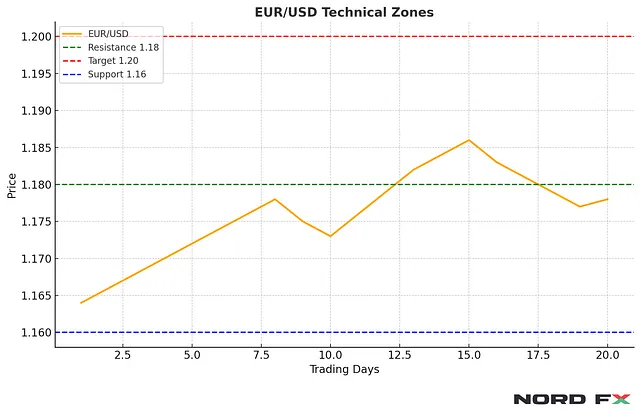
💵 Dollar — The greenback has lost momentum as softer US labour data and growing bets on multiple Fed cuts weigh it down. Treasury yields slipped, and the dollar index eased, opening space for rivals to recover. 🇪🇺 Eurozone — Growth remains weak overall, but there are signs of stabilisation. Unemployment has dropped to multi-year lows, and manufacturing PMIs have moved back above 50, pointing to cautious improvement despite Germany’s struggles and political risks in France. 📈 EUR/USD — The pair has rallied toward 1.18, adding nearly 1% in a month and about 6% over the year. A clear break above 1.18 could fuel a push to 1.20, while failure to hold risks a reversal in favour of the dollar. ⚖️ For traders — The battle has shifted: a weakening dollar vs a slowly recovering eurozone. Both breakout and pullback scenarios are in play, making this a critical moment for positioning. 🚀 Seize the opportunity with NordFX: 👉 https://account.nordfx.com/account/register?id=1187185 📊 Dollar Weakness vs Eurozone Resilience was originally published in Coinmonks on Medium, where people are continuing the conversation by highlighting and responding to this story

Author: Medium
Exploring CratD2C layer-1 blockchain with Founder and CEO Dr. Sammy Arogundade

Exploring CratD2C layer-1 blockchain with Founder and CEO Dr. Sammy Arogundade

CratD2C is a next-generation Layer-1 blockchain connecting businesses and consumers through real-world utility. Founded by Dr. Sammy Arogundade, the project combines speed, security, and sustainability with applications spanning e-commerce, real estate, DeFi, and more.  In this interview, Dr. Sammy shares the journey behind CratD2C, the launch of $CRAT coin, and how the project will shape […]

Author: Cryptopolitan
Crypto Markets Enter Their Most Crucial Macro Week In 2025 Yet

Crypto Markets Enter Their Most Crucial Macro Week In 2025 Yet

Crypto markets head into what could be a regime-setting macro week as “this week could reshape everything for the Fed and markets,” warned the @_Investinq account in a weekend thread that laid out a dense sequence of US macro catalysts landing between Tuesday and Friday. While the posts weren’t about crypto per se, the chain of events they describe—labor‐market revisions, wholesale and consumer inflation, jobless claims, energy inventories, and consumer expectations—map almost one-for-one onto the key drivers of the US dollar and Treasury yields. Those, in turn, are the two macro levers that most reliably move digital assets, with bitcoin historically trading inversely to both the dollar and real yields. Crypto Volatility Alert: Fed’s Make-Or-Break Data Week Is Here The week opens with an unusually consequential Tuesday: at 10:00 a.m. ET on September 9, the US Bureau of Labor Statistics will publish its preliminary benchmark revision to March 2025 payrolls alongside the QCEW. This is the annual “fact check” of the establishment survey that anchors jobs data to unemployment-insurance tax records covering more than 95% of payroll jobs. BLS has already flagged the timing; outside research shops have spent weeks priming markets for a significant down-adjustment. Goldman Sachs estimates a reduction on the order of 550,000 to 950,000 jobs for the twelve months through March 2025—potentially the largest 12-month markdown since 2010—an expectation echoed across several market digests and news outlets. Related Reading: Crypto Bull Run: Probability Of Fed Rate Cuts In September Almost At 100% The context matters: last year’s preliminary benchmark for March 2024 carved 818,000 jobs off previously reported totals, the biggest hit since the Great Financial Crisis, and it drove a reassessment of labor momentum into the fall. @_Investinq framed it this way: “Think of it as a yearly ‘fact check’ on job growth.” For crypto, a sizable downward revision would validate the “growth-is-slowing” narrative now feeding rate-cut bets into the September FOMC, a backdrop that has historically coincided with softer USD and more supportive cross-asset liquidity. Wednesday morning brings the wholesale inflation check. July’s Producer Price Index re-accelerated to +0.9% m/m and +3.3% y/y, with “final demand” goods up 0.7% and services up 1.1%; the BLS singled out a near 39% jump in fresh and dry vegetable prices and noted that financial services, lodging, and airfares contributed to the services surge. Under the hoods, “core PPI” ex-food and energy rose 0.9% m/m and 3.7% y/y, while the broader trimmed core (excluding food, energy and trade services) advanced 0.6% m/m and 2.8% y/y. @_Investinq cautioned: “Both goods and services are running hot, making it harder for the Fed to dismiss inflation.” Another firm print for August PPI would stiffen the dollar, push up yields, and typically pressure rate-sensitive risk assets—including high-beta crypto. Conversely, a cool-down would ease those headwinds. The August PPI is due Wednesday, Sept. 10 at 8:30 a.m. ET. Energy is the second macro input mid-week. The EIA Weekly Petroleum Status Report hits Wednesday at 10:30 a.m. ET. Draws in crude stocks tend to push oil higher at the margin; higher energy costs feed directly into headline inflation and indirectly into core via transport and production costs. That’s not a crypto-specific datapoint, but it shapes inflation expectations and, by extension, real-yield dynamics that crypto trades against. All Eyes On The CPI The main event is Thursday’s Consumer Price Index, the last inflation read before the Fed’s September 16–17 meeting. In July, headline CPI rose +0.2% m/m and +2.7% y/y, while core CPI ticked up to 3.1% y/y from 2.9%, with sticky categories including shelter, healthcare, recreation, and auto insurance offsetting cheaper energy. “This CPI is the final inflation report before the September Fed meeting,” @_Investinq reminded followers. The August CPI lands Thursday, Sept. 11 at 8:30 a.m. ET. A softer-than-expected print would strengthen the case for a larger policy move, while a surprise re-acceleration—particularly in services—could cap a dovish reaction even if the Fed still cuts. For digital assets, the sign of the surprise matters: cool CPI tends to mean a weaker dollar and flatter real yields, both historically constructive for Bitcoin and the entire crypto market; hot CPI often does the opposite and usually hits altcoins hardest. Also Thursday at 8:30 a.m. ET, weekly jobless claims arrive—a high-frequency pulse on labor slack. “Low claims = strong labor = hawkish Fed. Rising claims = cracks in labor = dovish tilt,” as the @_Investinq thread put it. Markets increasingly treat this series as a tie-breaker when inflation is ambiguous. Officially, the Labor Department’s unemployment-insurance release hits every Thursday morning at 8:30. Friday closes with the University of Michigan preliminary September sentiment and inflation expectations at 10:00 a.m. ET. August sentiment fell to 58.2 (final) from 61.7, while 1-year inflation expectations rose to 4.8%, up from 4.5% in July—what the @_Investinq thread labeled a “toxic combo” of weaker mood and firmer expectations. Related Reading: Spot Crypto Trading Gets Major Green Light From US Regulators The Fed watches expectations closely because they tend to shape wage/price behavior; for crypto, higher expected inflation can be a double-edged sword: if it lifts yields and the dollar it’s a near-term drag, but in more extreme risk-off episodes it has also coincided with flows into “anti-debasement” narratives around BTC and gold. FOMC Looms Over Crypto All of this lands in a Fed blackout window ahead of the September decision. The FOMC calendar confirms a September 16–17 meeting, and after Friday’s soft jobs report (nonfarm payrolls +22,000, unemployment 4.3%), several banks moved to price in a cut, with some houses openly debating 25 vs 50 basis points depending on the CPI/PPI path this week. That debate is exactly why “a small decimal swing here could shift trillions,” as @_Investinq put it. From a crypto-specific lens, the distinction matters: a standard 25 bps cut with benign inflation likely weakens the dollar modestly and supports Bitcoin and crypto on the margin; a surprise-large 50 bps cut on the heels of large jobs revisions would underscore growth risk and could flatten the entire curve. The immediate setup therefore looks binary for crypto assets. If Tuesday’s benchmark revision is large and Thursday’s CPI cools, the “USD down / yields down” impulse that crypto likes could reassert into the FOMC, potentially reinforcing a swing back to net inflows into crypto asset funds after episodic outflows in late August. If, however, PPI and CPI print hot, expect the dollar bid to harden, real yields to back up, and the pressure to fall disproportionately on high-beta altcoins while bitcoin’s relative strength—and spot ETF demand—acts as a cushion. As @_Investinq summarized, “This week isn’t just data, it’s the Fed’s last look before September… and markets will trade every decimal.” For crypto, that translation is straightforward: every tenth of a percentage point in PPI/CPI and every hundred thousand jobs in the benchmark revision will be read through the dollar–yields prism and priced first into BTC liquidity, then into altcoin beta. The calendar is set; the pivots will be macro. At press time, the total crypto market cap stood at $3.82 trillion. Featured image created with DALL.E, chart from TradingView.com

Author: NewsBTC
Luxury rivals BMW and Mercedes target Tesla and BYD with new electric SUVs

Luxury rivals BMW and Mercedes target Tesla and BYD with new electric SUVs

BMW and Mercedes are done watching Tesla and BYD play kings. The two biggest luxury brands from Europe have just thrown down the gauntlet with all-electric SUVs meant to take back the market. After Tesla’s Model Y exploded into the scene and crushed every legacy automaker’s pride, the Germans are now swinging back, with range, […]

Author: Cryptopolitan
Strategy founder: Confident that MSTR will be included in the S&P 500 index

Strategy founder: Confident that MSTR will be included in the S&P 500 index

PANews reported on September 8 that according to CNBC, Strategy founder Michael Saylor said: "I am confident that MSTR will be included in the S&P 500 index. The market is undergoing digital transformation. This is a brand new concept. MSTR has new supporters every quarter. We have received more support from banks, politicians and credit rating agencies."

Author: PANews
September’s Picks: Best Crypto Presales To Buy For Long-term Gains – Your $100 Today Could Be $5000 in 6 Months

September’s Picks: Best Crypto Presales To Buy For Long-term Gains – Your $100 Today Could Be $5000 in 6 Months

According to the sixth annual Chainalysis Global Crypto Adoption Index, India has emerged as the top country for retail participation, […] The post September’s Picks: Best Crypto Presales To Buy For Long-term Gains – Your $100 Today Could Be $5000 in 6 Months appeared first on Coindoo.

Author: Coindoo
Venezuela: USDT becomes the daily currency amid inflation and the collapse of the bolívar

Venezuela: USDT becomes the daily currency amid inflation and the collapse of the bolívar

In Venezuela, amidst skyrocketing inflation and the collapse of the bolívar, daily expenses such as rent and receipts are increasingly being settled in USDT.

Author: The Cryptonomist